
1990s Marvel Cards Are Still Mispriced
Thirty years of junk-wax pricing hid real condition scarcity in a handful of cards tied to characters that got much bigger.
A small group of 1990s Marvel cards still looks mispriced. Not because the cards were rare when they were printed. They were not. The opportunity is that the market spent three decades treating almost the entire category as junk wax, while time has created real condition scarcity in a handful of cards tied to characters that became far more valuable after the cards were made.
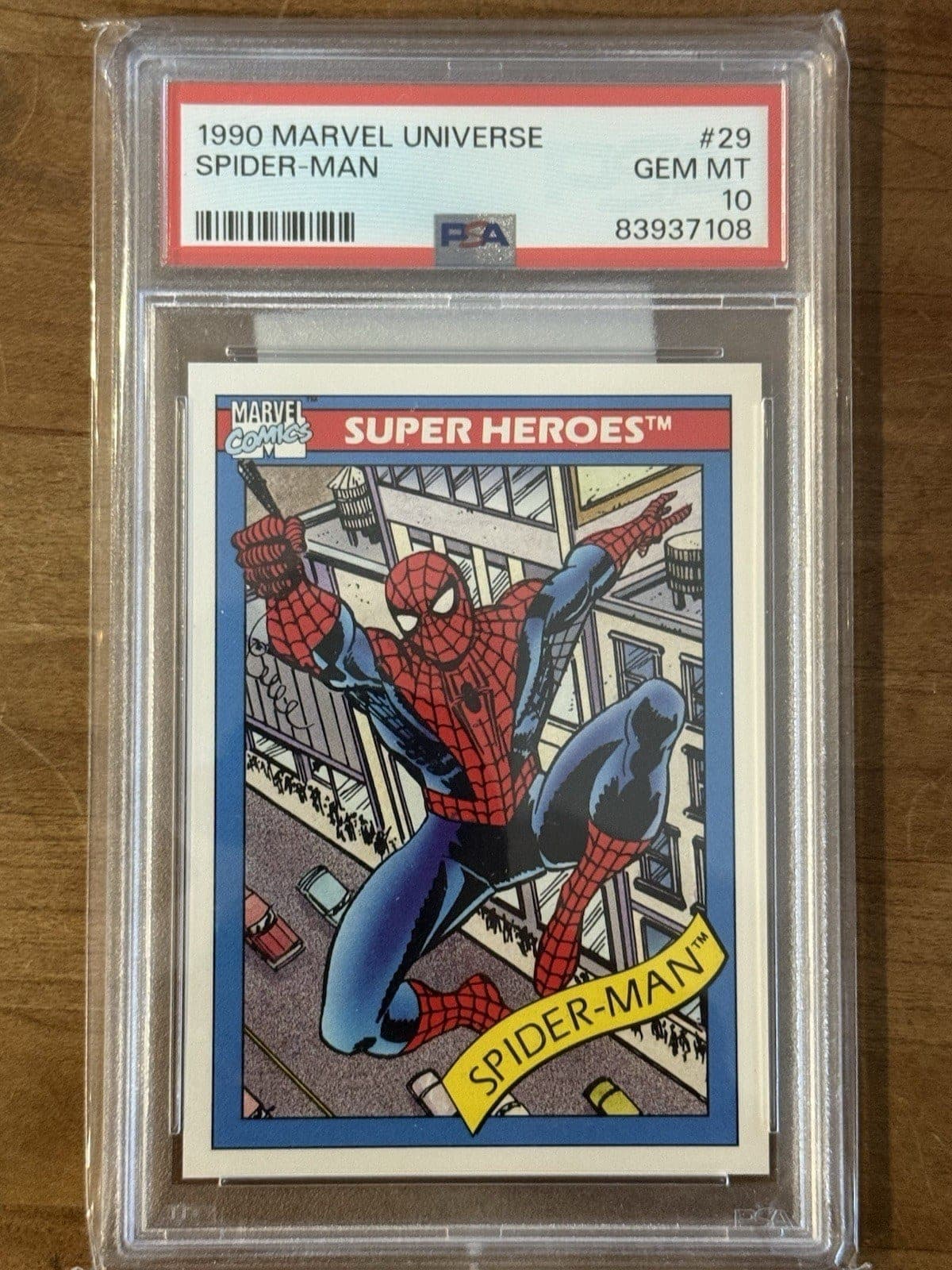
The re-rating has already started. A 1990 Marvel Universe Spider-Man #29 in PSA 10 sold for $825 USD in June 2026, and five copies sold in August 2026 between $1,425 USD and $1,700 USD. Wolverine #10 sold for $128 USD in December 2025 and copies sold in August 2026 between $230 USD and $450 USD. The 1992 Marvel Masterpieces Spider-Man #87 sold for $689 USD in February 2026 and for $2,250 USD on August 24, 2026.123
This is no longer a story about a completely ignored market. It is a market beginning to decide which cards matter.
1990 Marvel Universe Spider-Man #29 in PSA 10. Sold for $825 USD in June 2026; five copies sold in August 2026 between $1,425 USD and $1,700 USD.
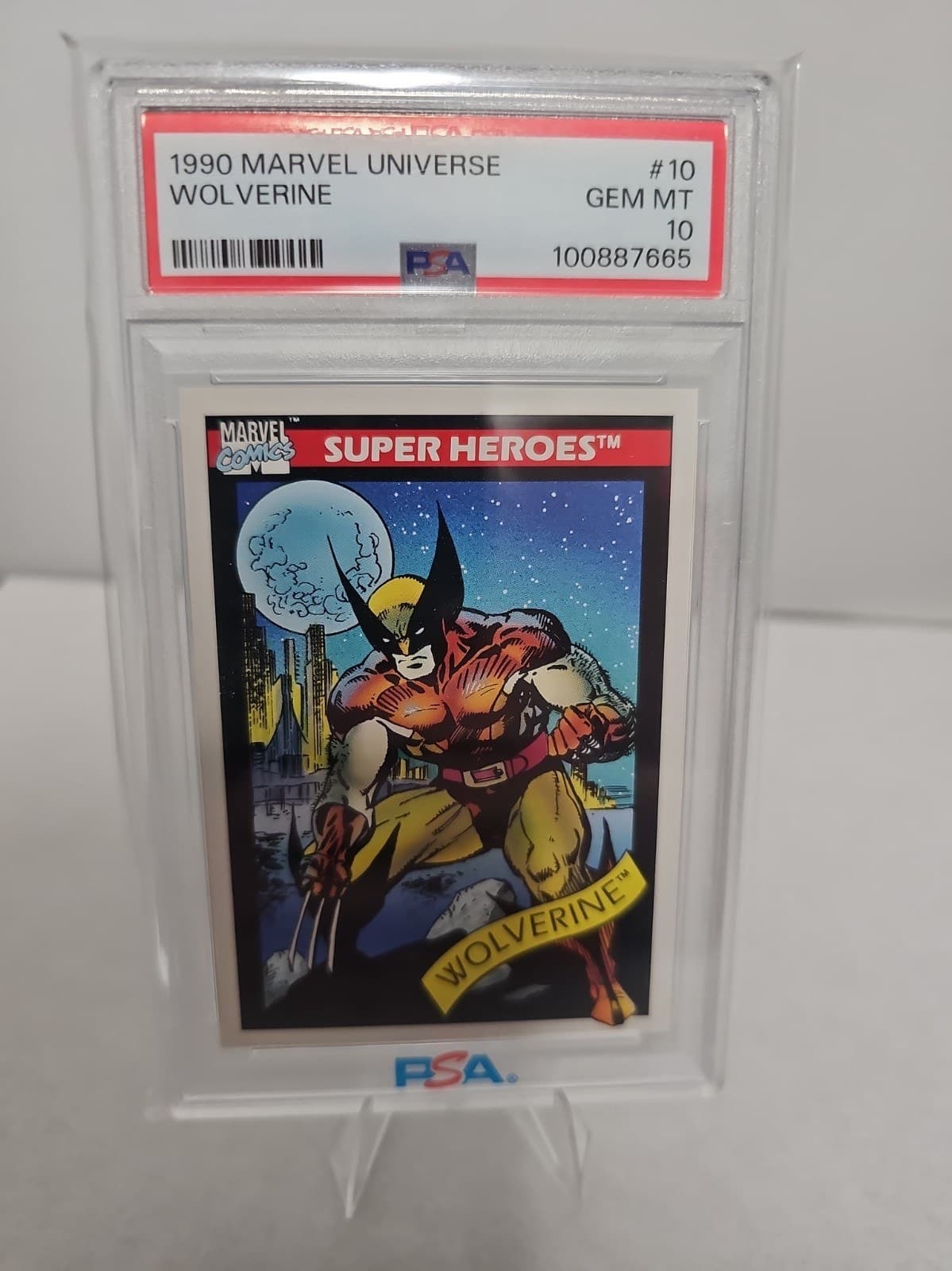
1990 Marvel Universe Wolverine #10 in PSA 10. Sold for $128 USD in December 2025; copies sold in August 2026 between $230 USD and $450 USD.
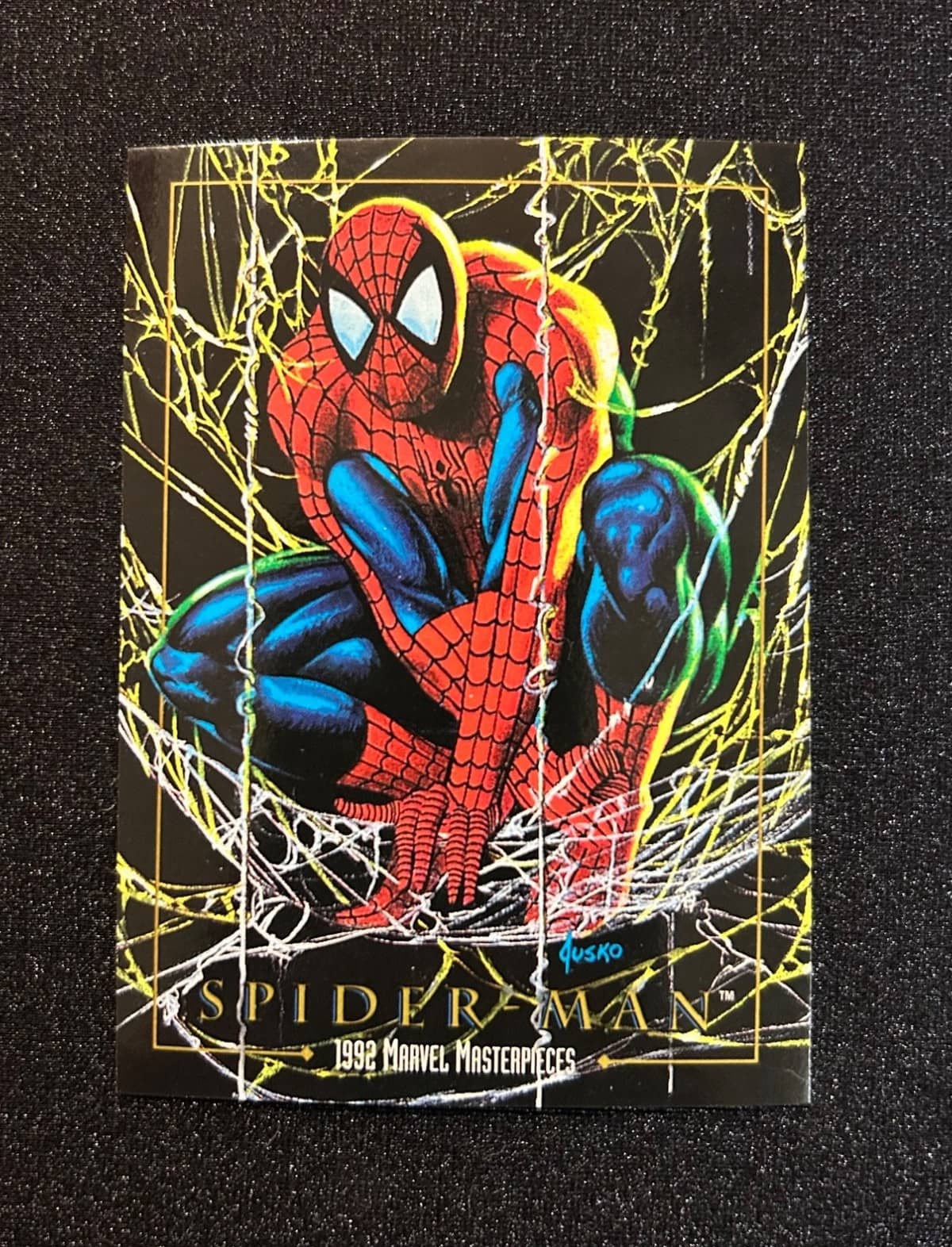
1992 Marvel Masterpieces Spider-Man #87 in PSA 10. Sold for $689 USD in February 2026 and for $2,250 USD on August 24, 2026.
Why did Marvel cards stay cheap for so long?
Because the print runs were enormous and nobody could agree on which card mattered. The 1990s were an era of huge production. FPG says 350,000 boxes of 1992 Marvel Masterpieces were produced to meet demand.4 The 1990 Marvel Universe set was also a mass-market product, sold in 36-pack boxes and distributed broadly enough that raw cards remain easy to find today.5
Marvel also lacks the clean hierarchy that makes sports and Pokemon easy to price. Spider-Man's true first appearance is a 1962 comic book, not a trading card. Wolverine's key first appearance is in The Incredible Hulk #181. Thousands of trading cards compete for attention. There is no universally accepted Spider-Man rookie card that concentrates demand the way a 1986 Fleer Michael Jordan or a 1999 first-edition Charizard does.
That pushed the investment premium into comics while the cards remained souvenirs. For years, there was little reason for investors to distinguish a perfect 1990 Spider-Man from one pulled from a childhood binder.
Grading changed that. It created a second supply number.
The print run is not the surviving supply
There are many 1990 Marvel Universe cards. There are currently 249 PSA 10 copies of Spider-Man #29. There are 82 PSA 10 copies of the 1992 Marvel Masterpieces Spider-Man #87.13
The difference becomes extreme with the 1990 holograms. GemRate counts 10,075 PSA-graded holograms across the five-card set and only 51 PSA 10s. Wolverine has 10 gems out of 2,251 graded copies. Spider-Man versus Green Goblin has four out of 1,675. Across the entire hologram set, the PSA 10 rate is roughly 0.5%.6
This is not manufactured scarcity. Nobody at Impel decided in 1990 that only ten flawless Wolverine holograms would exist in 2026. The scarcity emerged from printing quality, centering, scratches, handling and thirty-six years of survival. Condition alone caps the count at the top grade. Collectors pay for that gap on modern cards too, where a PSA 10 costs multiples of a PSA 9.
That does not make every PSA 10 automatically cheap. Thin populations can also produce thin markets, and a low-pop card with no demand is still a bad investment. The important part is the combination: genuine condition scarcity attached to characters with enormous and persistent demand.
The card canon is beginning to form
The strongest investment case is concentrated in two sets.
1990 Marvel Universe has a claim to being the foundational modern Marvel card set. PSA describes it as the first mass-produced trading-card set focused on Marvel's major superheroes. It put Spider-Man, Wolverine, Captain America and the X-Men into a card format built around characters, statistics, biographies and chase holograms. The product was ignored for decades, then experienced its first major repricing in 2021 as 1990s nostalgia and Marvel's film audience converged.5
1992 Marvel Masterpieces has a different claim. Joe Jusko created 104 original paintings for the set, and the images became collectible art in their own right. FPG says 350,000 boxes were needed to meet the original demand. The huge production run is exactly why raw supply is not the investment case.
Those two sets are beginning to give investors something Marvel cards historically lacked: a simple hierarchy. One is the first mass-market Marvel Universe set. The other is the defining painted-art set of the decade. Spider-Man and Wolverine are the clearest anchors, with Venom and the major X-Men characters behind them.
The market does not need to decide that every 1990s Marvel card matters. It only needs to agree on a handful.
Modern Marvel shows where the money is going
There is no shortage of demand for Marvel cardboard. Investors are already paying substantial premiums for newly created scarcity.
A 2025 Topps Chrome Marvel Comics hobby box retailed at $240 USD and sold on StockX for a three-month average near $399 USD through August 2026. Topps Chrome Marvel Sapphire retailed at $329 USD and sold for roughly $486 USD on the same measure through August 2026. Asks on the standard box sat above $400 USD in August 2026.7
At the top end, a 2025 Topps Chrome Marvel Spider-Man SuperFractor one-of-one sold at Goldin for $31,842 USD in March 2026.8
The modern card is genuinely scarcer. There is only one SuperFractor. The comparison is not that a 1990 Spider-Man should reach the same number. It is that the market has already accepted Marvel as a serious high-end card category. Much of that capital is currently paying for scarcity that Topps created last year, the same way Topps built the scarcity around LeBron James's first 76ers card, while the most recognizable cards from the actual 1990s collecting era remain in the low thousands.
That gap is what makes the older cards interesting.
1990s nostalgia is already being monetized everywhere else
eBay opened a physical "'95 Shop" in New York in 2025 built around the objects that defined the decade. Pokemon was the most-searched term in eBay's collectibles category every month that year. Michael Jordan was its most-searched athlete. A first-edition Shadowless Charizard in PSA 10 sold on eBay for more than $270,000 USD in August 2025.9
Marvel is not missing from the nostalgia cycle culturally. eBay's 2025 data showed Amazing Spider-Man, X-Men and Fantastic Four among its most-searched superhero series. Ahead of the Fantastic Four film, searches for Mr. Fantastic increased 220% year over year, Sue Storm 120%, Johnny Storm 110% and The Thing 70%.10
The characters have been repriced. The movies have been repriced. The comics have been repriced. New Marvel cards are being financialized using the same numbered parallels and premium-box economics as sports cards.
The early 1990s cards are the lagging asset.
Sealed product may be the cleaner trade
Individual PSA 10s require getting the card hierarchy right. Sealed product reduces that risk, but you don't get the gambler's premium for ripping.
Sealed 1990 Marvel Universe boxes sold around $590 USD and 1992 Marvel Masterpieces boxes around $510 USD on PriceCharting, read in August 2026. The 1990 box sold for $100 USD or less before the pandemic and reached roughly $700 USD to $1,000 USD by June 2021.11125
That history matters. The first Marvel spike was real, but it was also part of a speculative collectibles boom. Prices fell when the broader market cooled.
The current setup is different. Modern Marvel product itself sold around $400 USD to $500 USD per box through August 2026. A sealed box from 1990 or 1992 therefore costs only modestly more than a premium box manufactured in 2025. Every old box opened permanently reduces surviving sealed supply. Topps can print another new Marvel set next year.
For investors who believe the category will develop a stronger historical hierarchy, sealed boxes from the two foundational sets may be the simplest expression of that view.
What I would own
The investment case gets weaker the farther it moves from recognizable characters, defining sets and demonstrable scarcity. I would keep it narrow.
- 1990 Marvel Universe Spider-Man #29 and #30 in PSA 10. The clearest character, the foundational set and limited gem populations. #29 already has enough transactions to support real price discovery; #30 is harder to center and has a smaller top-grade population.
- 1990 Marvel Universe holograms in PSA 10. The strongest condition-scarcity argument in the set. The risk is liquidity: populations this small can produce large price gaps and infrequent sales.
- 1992 Marvel Masterpieces Spider-Man #87 in PSA 10. Jusko's artwork, a low PSA 10 population and strong 2026 price action make it the clearest Masterpieces benchmark.
- Sealed 1990 Marvel Universe and 1992 Marvel Masterpieces boxes. A broader bet on the sets themselves, with a supply base that can only decline as boxes are opened.
I would not buy raw base cards simply because they are old, and I would not treat low PSA populations as enough by themselves. More unopened material can still surface, grading populations can rise, and Marvel cards remain less liquid than major sports and Pokemon cards.
The more important risk is that comics continue to absorb most of the historical premium. A collector who wants Spider-Man history can buy an early comic, but for card collectors, the 1990 set is the way to go.
If the card market never develops an accepted price hierarchy and canon separate from comics, the discount can persist indefinitely. But the 2026 price action suggests that canon is beginning to form.
The Marvel re-rating
The original supply of 1990s Marvel cards is not the reason to buy them. It is the reason they stayed cheap.
The investment case begins after thirty-plus years of attrition, grading and cultural expansion. The most important Marvel characters are now larger than they were when these cards were printed. Investors have learned to pay for graded condition, sealed supply and explicit scarcity. Modern Marvel cards have demonstrated that the franchise can support five-figure card sales. And a small group of early cards is beginning to separate from the mass-produced base around it.
The market does not need to revalue 1990s Marvel cards. It needs to revalue the few cards it eventually decides represent 1990s Marvel.
That process appears to have started. The open question is whether these levels are the end of the move, or simply what these assets cost before Marvel cards developed the same historical hierarchy that investors already take for granted in sports and Pokemon.
Notes
- PSA, 1990 Marvel Universe Spider-Man #29. PSA population 249 as of August 2026; five verified August PSA 10 sales from $1,425 USD to $1,700 USD. PriceCharting records a June 26, 2026 PSA 10 sale at $825 USD and a May 2020 PSA 10 sale at $103 USD. psacard.com ↩
- PSA, 1990 Marvel Universe Wolverine #10. PSA population 650 as of August 2026; a December 26, 2025 PSA 10 sale at $128 USD and August 2026 sales from $230 USD to $450 USD. psacard.com ↩
- PSA, 1992 Marvel Masterpieces Spider-Man #87. PSA population 82 as of August 2026; Fanatics Collect sales at $689 USD on February 25, $1,600 USD on August 21 and $2,250 USD on August 24, 2026. psacard.com ↩
- FPG Universe, "Joe Jusko's Art of the 1992 Marvel Masterpieces." FPG states that 350,000 boxes were produced and that Jusko created 104 original paintings for the set. ↩
- PSA, Kevin Glew, "1990 Marvel Universe Set, Finally Being 'Marveled,'" February 16, 2022. PSA describes the issue as the first mass-produced set focused on Marvel's major superheroes and records sealed-box prices of $100 USD or less before the pandemic and roughly $700 USD to $1,000 USD by June 2021. psacard.com ↩
- GemRate, 1990 Marvel Universe Hologram PSA Advanced Stats Pop Report, updated August 24, 2026. 51 PSA 10s across 10,075 total PSA grades; individual gem rates range from 0.2% to 0.9%, and none of the 60 holograms graded in the most recent 30-day period received a PSA 10. gemrate.com ↩
- StockX, 2025 Topps Chrome Marvel Comics Hobby Box and 2025 Topps Chrome Marvel Sapphire Edition Hobby Box, market data accessed August 2026. Standard Chrome retail price $240 USD and three-month average sale price about $399 USD; Sapphire retail price $329 USD and three-month average about $486 USD. stockx.com ↩
- Figoca, citing Goldin, March 2026, on the 2025 Topps Chrome Marvel Clawed Chrome Spider-Man SuperFractor 1/1 in PSA 9, sold for $31,842 USD. ↩
- eBay, "eBay Opens the '95 Shop, Celebrating 30 Years of Cultural Icons," September 3, 2025, and eBay Collected 2025. Pokemon was eBay's most-searched collectibles term every month in 2025; Michael Jordan was its most-searched athlete; a first-edition Shadowless Charizard in PSA 10 sold for more than $270,000 USD in August 2025. ebayinc.com ↩
- eBay Collected 2025. Amazing Spider-Man, X-Men and Fantastic Four ranked among the most-searched superhero series; Fantastic Four character searches rose 70% to 220% year over year from January through October 2025. ebayinc.com ↩
- PriceCharting, Marvel 1990 Universe Sealed Box, accessed August 2026. Current algorithmic market price approximately $590 USD, based on completed sales; volume approximately one sale per week. pricecharting.com ↩
- PriceCharting, Marvel 1992 Masterpieces Sealed Box, accessed August 2026. Current algorithmic market price approximately $509.50 USD, based on completed sales; volume approximately one sale per week. pricecharting.com ↩