
Everyone Hates PSA. Everyone Still Wants a PSA 10.
PSA is expensive, backlogged and endlessly criticized. But the market still pays double for its 10s. Why?
The most important fact about a PSA 10 is not the number 10. It is the three letters before it.
Collectors argue endlessly about whether PSA is too lenient, too inconsistent, too expensive or too opaque. Some prefer Beckett's subgrades. TAG can show a collector a 1,000-point score and a digital map of defects. CGC reserves its top Pristine 10 for cards it says are flawless under magnification. SGC built a loyal following around speed, price and vintage cards.
None of them has displaced PSA.
Cards PSA graded in July 2026 (GemRate July recap, Aug. 3, 2026).
PSA share of July 2026 volume among the five graders GemRate tracks.
PSA active global backlog as of Aug. 25, 2026, per its own tracker, even after pausing Value tiers.
That combination is the paradox. PSA has enough unhappy customers to support years of criticism, competitors with genuinely attractive technology, and a backlog measured in eight figures. Collectors still send it more cards than every major rival combined.12
The PSA 10 premium is justified economically. That does not mean it is justified scientifically.
PSA is not winning by a little
In July 2026, the five graders tracked by GemRate graded about 3.61 million cards. PSA alone handled 2.49 million. CGC graded 856,000, Beckett 161,000, TAG 57,000 and SGC 44,000.1
Roughly 69% of the five-company total (GemRate, Aug. 3, 2026).
Includes approximately 60,000 semi-rigid AUTH cards noted by GemRate.
Third by volume in July 2026.
The technology challenger, still under 2% of the tracked total.
Acquired by PSA parent Collectors in 2024.
Set-level data can be even more lopsided. GemRate's Universal Population Report shows PSA holding 78.4% of grades for 2025 Topps Baseball and 85.6% of grades for 2025 Pokémon Mega Evolution.34
This is not simply legacy vintage collectors refusing to change. PSA is dominant in modern sports and modern Pokémon, exactly where newer graders should theoretically have the best chance to win.
A PSA 10 is not actually a perfect card
PSA's own standard is revealing. It calls a PSA 10 a "virtually perfect" card, not a perfect one. A slight printing imperfection can be allowed. Front centering can be approximately 55/45 and reverse centering can reach 75/25.5
PSA also explicitly acknowledges that grading includes a subjective component. Its published standards say graders can make judgment calls based on eye appeal and market acceptability, including rare cases where a card technically inside or outside a printed centering threshold is treated differently because of how it presents.6
That is not necessarily a flaw. Condition is partly aesthetic. But it destroys one common explanation for the PSA premium: that a PSA 10 is simply an objectively superior physical card.
Approximately 55/45 front centering permitted; a slight print imperfection may be acceptable (PSA Grading Standards).
50/50 centering; CGC says Pristine 10 cards are flawless under 10x magnification.
Four perfect 10 subgrades; 50/50 front centering standard.
1,000-point score, defect annotations and a leaderboard rank within the grade.
Competitors can credibly offer more information. Beckett evaluates centering, corners, edges and surface and can display all four subgrades. TAG's premium report can provide eight subgrades, a 1,000-point score, high-resolution imaging and defect annotations. CGC separates Gem Mint 10 from Pristine 10, with the latter requiring a stricter condition threshold.789
All of that information is on offer, and PSA still graded 69% of July's cards.1 Whatever a collector is buying when they pick a grader, it is more than measurement.
The market does not treat all 10s as the same asset
Sports Card Investor's price guide shows a 2024 Topps Chrome Elly De La Cruz #44 in a PSA 10 sold for $59.99 on July 6, 2026. The same card in an SGC 10 last sold for $30.00 on June 21, 2026.1011
Same player. Same set. Same card number. Both slabs say 10. The PSA copy sold for about twice as much.
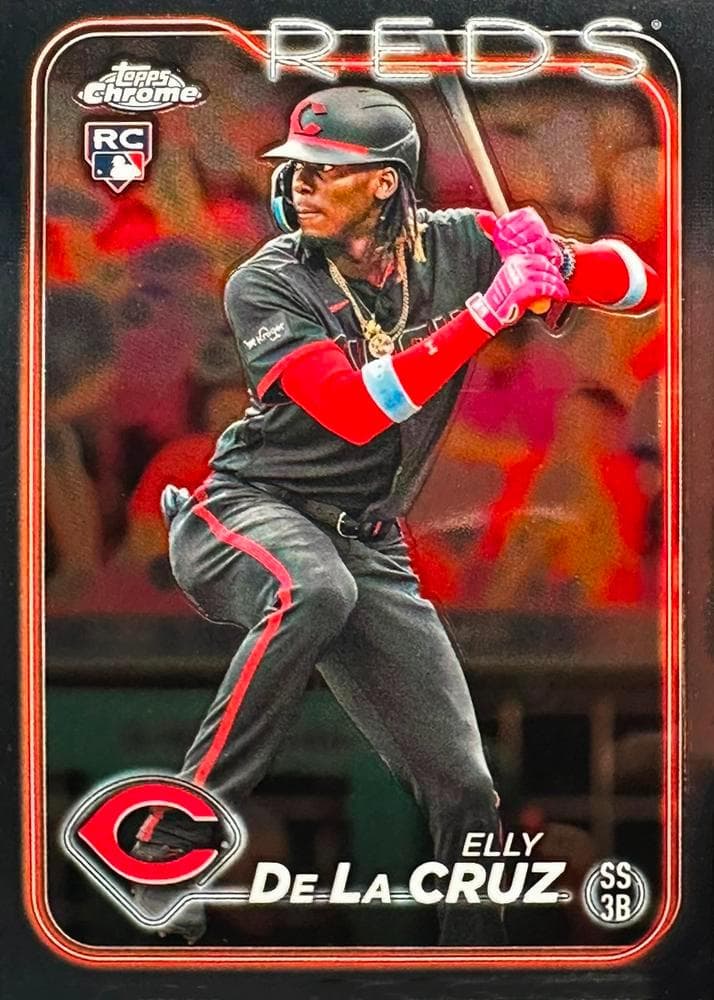
The premium is not proof that the PSA card is physically better. It is proof that buyers assign value to the holder and label.1011
Pokémon makes the point even more clearly. Recent cited sales of the 2023 Pokémon 151 Charizard ex #199 in a PSA 10 generally clustered between $1,350 and $1,575 in August 2026, with some higher transactions. CGC Gem Mint 10 copies commonly sold between $660 and $810 in July 2026.12
But the hierarchy flips at the truly elite end. CGC Pristine 10 examples of that same Charizard have sold for $2,000 and more, most recently in August 2026. The market is capable of rewarding a non-PSA slab when the grade itself signals a meaningfully rarer condition tier.12

So the rule is not "PSA always sells for more."
A PSA 10 has become the default unit of gem-mint value. A competitor has to offer something meaningfully different to escape that benchmark.
PSA built a network, not just a grading room
This is the strongest explanation for PSA's durability.
The PSA Set Registry was established in 2001 and by August 2026 held roughly 335,000 registered sets, creating decades of incentives for collectors to own PSA-certified cards that fit existing sets, rankings and completion goals.13
PSA also has a daily population report, certification verification, auction-price data, a price guide and direct links into Card Ladder. Then came marketplace infrastructure. In 2024, eBay and Collectors announced a commercial partnership under which PSA acquired the eBay Vault and the companies planned a more seamless path from grading to storage to an eBay listing.14
Every layer strengthens the next one:
| Network effect | Why it reinforces PSA |
|---|---|
| More submissions | Creates larger population data and more comparable sales. |
| More PSA sales | Gives buyers cleaner comps and sellers confidence they can exit. |
| More buyers searching "PSA 10" | Encourages sellers to submit to PSA even when another grader is cheaper. |
| Set Registry | Makes the holder itself part of collection completion. |
| eBay and vault integration | Reduces friction between grading, storage and resale. |
| Higher resale prices | Justifies paying PSA more, which reinforces submission volume again. |
This is why "another company grades more consistently" may be the wrong competitive thesis. A grading company does not beat PSA merely by producing a better grade. It has to break a liquidity loop.
PSA is winning despite the criticism
PSA's dominance should not be confused with a spotless record.
Altered cards have made it through
In 2019, The Washington Post reported on an FBI investigation into an alleged card-altering scheme in which collectors identified cards that appeared to have been altered, resubmitted to PSA and later auctioned. The reporting centered on hundreds of cards and raised a basic problem for any third-party grader: the entire economic promise of the slab depends on catching alterations that sophisticated card doctors want the grader to miss.15
PSA itself says grading is partly subjective
The company does not hide this. Its own grading standards reserve room for judgment calls based on eye appeal. That makes perfect consistency difficult by design.6
The backlog is extraordinary
PSA paused its four Value service tiers in June 2026 after a demand surge pushed its backlog toward 10 million cards. The backlog later reached 12.4 million and stood at approximately 10.9 million on Aug. 25. PSA says capacity has increased nearly five-fold since 2021 and has committed $200 million to infrastructure expansion.216
There may be no stronger evidence of brand power than a company temporarily shutting its cheapest lanes while millions of cards remain in line, and still grading 2.49 million cards in a single month.
PSA's parent has bought two of its rivals
Collectors, PSA's parent, acquired SGC in 2024. In December 2025 it announced a definitive agreement to acquire Beckett, while saying Beckett would continue as a separate brand with its own grading standards and operations.1718
A proposed class action filed in April 2026 alleges that the SGC and Beckett transactions unlawfully reduced competition in card grading. Collectors has moved to dismiss the case and has denied that the transactions were designed to maintain a monopoly. The litigation remains unresolved.19
The consolidation question is important, but it also reveals something about PSA's position before the acquisitions. SGC and Beckett were established brands with decades of history. Neither had overtaken PSA. A newer challenger now has to compete not only with a grading service, but with a mature market convention.
PSA 10 has become a brand, not just a grade
This is where the Pokémon analogy helps.
Pikachu is the face of Pokémon. Charizard became the cardboard icon. That outcome was not ordained by character design, objective importance to the franchise or scarcity alone. Collectors collectively decided which character represented the grail, and decades of transactions reinforced the choice.
PSA has reached a similar place in grading. "PSA 10" is a phrase collectors recognize instantly. It has become shorthand for the liquid, benchmark version of a modern card. A TAG 10 may provide more condition data. A BGS Black Label can be materially harder to obtain. A CGC Pristine 10 may be technically stricter. None of those facts make them the benchmark.
The holder is part of the asset. Once two physically similar cards trade at different prices because of the letters printed above the grade, the market has already answered the question.
So is the PSA 10 premium justified?
For an investor or reseller, usually yes. Not because we can prove PSA produces the most accurate 10, but because liquidity itself has value. A larger buyer pool, more comps, more registry demand and a familiar label can reduce the friction and uncertainty of selling.
For a collector who cares only about the physical card, often no. If an SGC 10, CGC 10 or BGS 9.5 contains a card you believe is physically equivalent and costs 20%, 30% or 50% less, paying the PSA tax may buy nothing you personally care about.
For condition absolutists, PSA may not even offer the highest signal. BGS Black Label, CGC Pristine and TAG Pristine create condition tiers above an ordinary gem-mint 10. The Charizard example shows that buyers can pay more for those rarer signals.
| Buyer | Is the PSA premium justified? | Reason |
|---|---|---|
| Short-term reseller | Usually | Liquidity and buyer recognition can outweigh grading-cost savings. |
| Long-term investor | Often | PSA is the benchmark most likely to remain easy to price and sell. |
| Pure collector | Depends | The discount in another holder may buy a better card for the same money. |
| Condition perfectionist | Not necessarily | Other companies have higher or more granular top-grade tiers. |
| Cross-grade arbitrageur | Potential opportunity | A discounted non-PSA slab may be valuable if the underlying card can cross into PSA at the desired grade. |
The real threat to PSA is not better grading
Collectors have been waiting for a competitor to beat PSA by being cheaper, faster, more transparent or more technologically sophisticated. All of those things can win customers. None has yet broken the benchmark.
The company that seriously threatens PSA will probably need to do something harder: create its own self-reinforcing market.
It needs enough supply that buyers see comps everywhere. Enough buyers that sellers stop fearing a liquidity discount. Enough marketplace integration that grading becomes one step in a seamless transaction. Enough cultural recognition that collectors search for the company's grade by name.
Until then, every PSA premium creates the incentive that keeps PSA dominant. Sellers grade with PSA because buyers pay more. Buyers pay more because they know the next buyer will recognize PSA.
PSA does not have to prove that its 10 is better than every other 10. It only has to remain the 10 everyone else is compared against.
The investment conclusion is not "PSA is the best grader." It is almost the opposite.
PSA may be strongest precisely because the argument about grading quality is no longer decisive. The brand has escaped the product.
Notes
- GemRate, "July 2026 Grading Recap," Aug. 3, 2026. PSA graded 2.49 million cards; CGC 856,000; Beckett 161,000; TAG 57,000; SGC 44,000. gemrate.com ↩
- PSA, Backlog Tracker, Aug. 25, 2026 update. Active global backlog approximately 10.9 million cards. psacard.com ↩
- GemRate Universal Population Report, 2025 Topps Baseball, updated Aug. 25, 2026. PSA share of grades 78.4%. gemrate.com ↩
- GemRate Universal Population Report, 2025 Pokémon Mega Evolution, updated Aug. 26, 2026. PSA share of grades 85.6%. gemrate.com ↩
- PSA, Grading Standards. PSA 10 is defined as "virtually perfect"; standards permit approximately 55/45 front centering and a slight printing imperfection if overall appeal is not impaired. psacard.com ↩
- PSA, "The Importance of Eye Appeal and Subjectivity in Grading," within PSA Grading Standards. PSA describes grading as partly subjective and permits grader judgment based on eye appeal in borderline cases. psacard.com ↩
- Beckett Grading Services, current grading standards. BGS evaluates centering, corners, edges and surface; Black Label Pristine 10 requires four 10 subgrades. beckett.com ↩
- TAG Grading, current Standard service and DIG report documentation. TAG offers 1,000-point scoring, defect annotations, subgrade metrics and high-resolution imaging on applicable service levels. taggrading.com ↩
- CGC Cards, current grading scale. CGC Pristine 10 requires 50/50 centering and is reserved for cards that are virtually flawless to the naked eye and meet its stricter magnified standard. cgccards.com ↩
- Sports Card Investor, 2024 Topps Chrome Elly De La Cruz #44 PSA 10 Price Guide. Last cited sale $59.99 on July 6, 2026. sportscardinvestor.com ↩
- Sports Card Investor, 2024 Topps Chrome Elly De La Cruz #44 SGC 10 Price Guide. Last cited sale $30.00 on June 21, 2026. sportscardinvestor.com ↩
- PriceCharting, 2023 Pokémon Scarlet & Violet 151 Charizard ex #199. PSA 10, CGC Gem Mint 10 and CGC Pristine 10 sales used in the comparison; the page's sales log shows a CGC Pristine 10 sold for $2,000.00 on Aug. 9, 2026, desk-checked Sept. 1, 2026. pricecharting.com ↩
- PSA Set Registry, current registry totals and history. Established in 2001; approximately 335,000 registered sets as of August 2026. psacard.com ↩
- eBay Inc., April 10 and May 16, 2024. eBay and Collectors announced a commercial agreement, PSA's acquisition of the eBay Vault and integrated grading, vaulting and selling plans. investors.ebayinc.com ↩
- The Washington Post, July 18, 2019. Reporting on the FBI investigation into alleged alteration of valuable cards that were later graded and auctioned. washingtonpost.com ↩
- PSA, May 28, 2026 service update. PSA paused Value tiers after a submission surge and announced a $200 million infrastructure investment. psacard.com ↩
- Sports Collectors Daily, Feb. 29, 2024. Collectors Holdings, PSA's parent, acquired SGC; SGC said it would remain an independent grading brand. sportscollectorsdaily.com ↩
- Collectors, Dec. 15, 2025. Collectors announced a definitive agreement to acquire Beckett and said Beckett would remain a separate brand with its own grading standards and operations. collectors.com ↩
- Bloomberg Law and Law360, April through June 2026. A proposed class action alleges Collectors' SGC and Beckett transactions violated federal antitrust law; Collectors has moved to dismiss. news.bloomberglaw.com ↩