
What Happens to Card Prices When a Career Ends
Death, retirement and Hall of Fame induction all look like catalysts. The data shows only some of them actually move the market.
Collectors assume a career milestone should lift a player's market. Retirement closes the book. Hall of Fame induction confirms the legacy. Both get treated as events that ought to firm up demand and push prices up.
The market says otherwise. By the time a veteran retires on schedule or gets inducted, collectors have had years to see it coming, and most of that is priced in before the announcement arrives.
The events that produce clean price reactions are the ones that change expectations. An unexpected retirement shortens a career and rewrites what the future was worth. A death is less predictable still, and brings an immediate wave of attention. Hall of Fame election is usually the formal confirmation of something the market already believed. The stats already told the story.
Cards respond to surprise, not to greatness. By the time a great player retires on schedule or reaches the Hall of Fame, the market has had years to agree with you.
How much new information actually arrives?
The useful way to hold retirement, election and death is not as three milestones in a life. They are three information events, and they differ in how much they tell you that you did not already know.
| Event | New information | Why |
|---|---|---|
| Death | High | Unpredictable timing, and attention arrives all at once |
| Surprise retirement | Medium | Career length changes without warning |
| Hall of Fame election | Low | Player statistics and personal accolades. |
The Hall of Fame is the easiest case. On top of personal accolades during a players' career, Baseball's public ballot tracker exposes much of the electorate before the announcement anyway. Ten hours before the 2026 results, 229 ballots, about 54 percent of the electorate, were already public, and Andruw Jones sat at 82.5 percent in the tracker against a final 78.4 percent.12
The announcement mattered as biography. It did not matter much as information.
Mariano Rivera is the same lesson from the other direction. He became the first unanimous BBWAA selection in history in 2019, and there is extensive coverage of the vote, the induction and the cards Topps made around it. A review of the available market data found no unusual price movement tied to the announcement itself.3
The clearest attention shock we have
Death produces the opposite setup. The timing is a shock and the attention can be enormous.
O.J. Simpson is a complicated subject for collectors, because his football career is inseparable from the murder trial that followed it and from his later legal battles. Even so, his 1970 Topps rookie in PSA 7 is close to a laboratory case. A copy sold for $250 the day before his death in April 2024, and the same file records a post-death peak that sold for $2,289 in April 2024.4
There was no hobby-wide crash between those two observations, and no championship, vote or product release to explain the move. The player died, attention exploded, buyers raced for the cheapest version of the rookie they could find.
Then it went back. The same card sold around $281 in Aug 2026.4
Retirement only matters when retirement is news
Tom Brady is the anticipated version, and his market still moved when the probability changed. eBay measured Brady collectible sales up 198 percent, rookie-card sales up 233 percent and searches for his rookie cards up 476 percent across January 23 to 29, 2022, before he confirmed anything on February 1.5
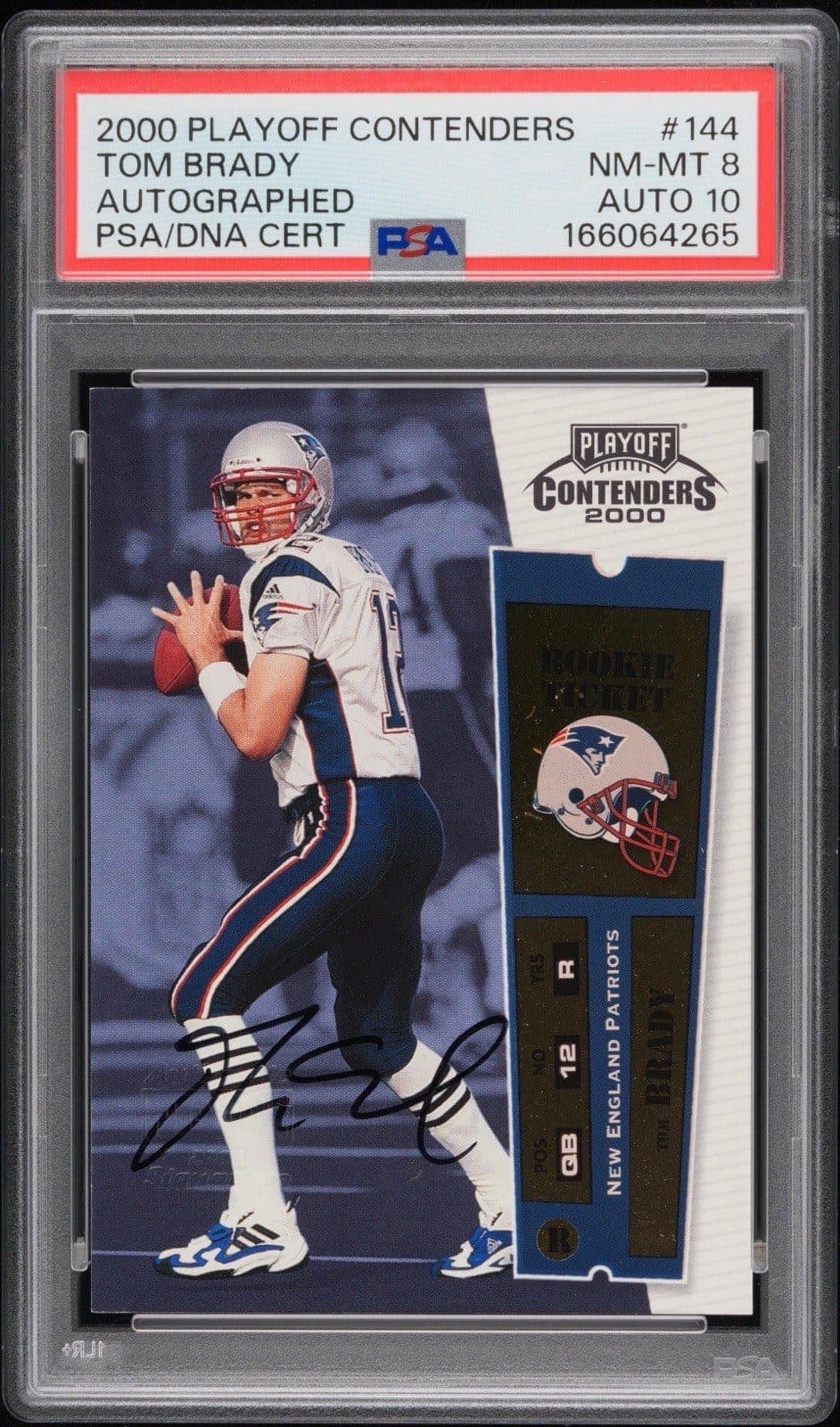
The sharpest Brady example is not a card. The football from what looked like his final touchdown sold for $518,628 in March 2022. The next day he announced he was coming back and the sale was voided.6 Same object, same provenance, one sentence in the description no longer true.
Andrew Luck is the extreme at the other end. He walked away in 2019 before turning 30, having just returned to Pro Bowl form, and hobby reporting immediately described a collapse in his premium rookie market.7 The market data records roughly a 67 percent drop in the relevant comparison inside a week.
So retirement is not bullish or bearish. Expected retirement is mostly priced in. A surprise change in career length is not.
Death is not a supply shock in cards
This is where cards separate from art.
Pénasse, Renneboog and Scheinkman studied premature artist deaths and found prices rose 54.7 percent and secondary-market volume rose 63.2 percent, with the effect persisting.8 The mechanism is intuitive. When an artist dies early, future production stops and the float (e.g., number of cards produced that could be graded, but aren't yet) is permanently smaller than buyers expected.
That does not map onto cards. The population of 1952 Topps Mickey Mantles was fixed in 1952. Willie Mays dying in 2024 eliminated no future 1951 Bowman Mays rookies, because none were ever going to exist. If anything, death produces more tribute cards, more commemorative products and more grading submissions.
There is a second effect worth testing: the graded float may rise after a death. Attention pulls raw cards out of drawers, and owners submit copies that were not worth grading before the spike. Populations can climb at the exact moment the market is telling itself the player got scarcer.
In art, death can close the float. In cards, the vintage float closed decades ago. What death creates is attention, and the default expectation should be decay.
Where the death premium actually lands
Kobe Bryant's death produced one of the most dramatic frenzies ever recorded, and the size of the move depended on which card you held.
The Topps Chrome Refractor in PSA 10 went from about $21,576 to $37,600 across January 2020.
The raw 1996 Fleer Metal went from roughly $1 to $4 before his death to $158 to $293 after.
That makes economic sense. A sudden wave of attention brings in buyers who want a Kobe rookie, not the best Kobe rookie. The easiest supply to absorb is the cheap, liquid, high-population card. Trophy assets are already held by people who do not have to sell, and they start from a much higher price.
Death effects should be strongest where the buyer pool can expand fastest.
The counter-example that proves the rule
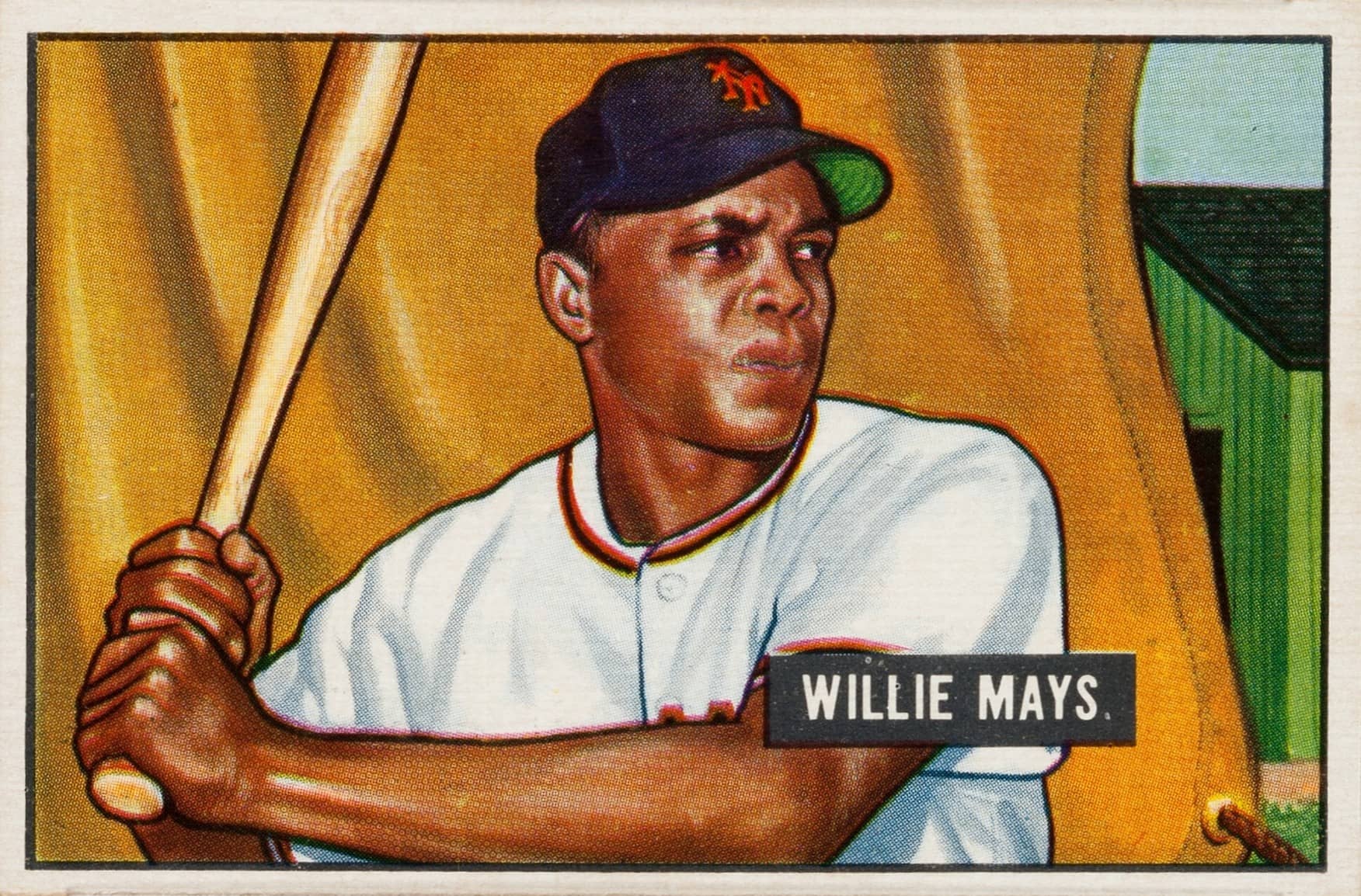
Willie Mays died on June 18, 2024. A 1951 Bowman Mays in PSA 8 had sold for $186,000 earlier that month, and Heritage sold another PSA 8 for $174,000 in August 2024, after his death.10 The price went down.
That does not disprove a death effect. It shows why you cannot read one off a headline sale. Mays was 93, his standing was fully known, and his rookie was already a trophy asset. The market did not need his death to find the card. Over the following year the market data has him materially underperforming comparable icons.
Pete Rose, and what a real surprise looks like
Rose was barred from baseball in 1989 for gambling on games while managing the Reds, which also kept him out of the Hall of Fame despite being the all-time hits leader. He died on September 30, 2024. Then, in May 2025, Major League Baseball removed deceased players from the permanently ineligible list, making him eligible for future consideration.
Two potential catalysts inside a few months. The market data records month-over-month gains across grades of his 1963 Topps rookie after the May 2025 change: PSA 8 up 41 percent, PSA 4 up 45 percent, PSA 2 up 52 percent.13
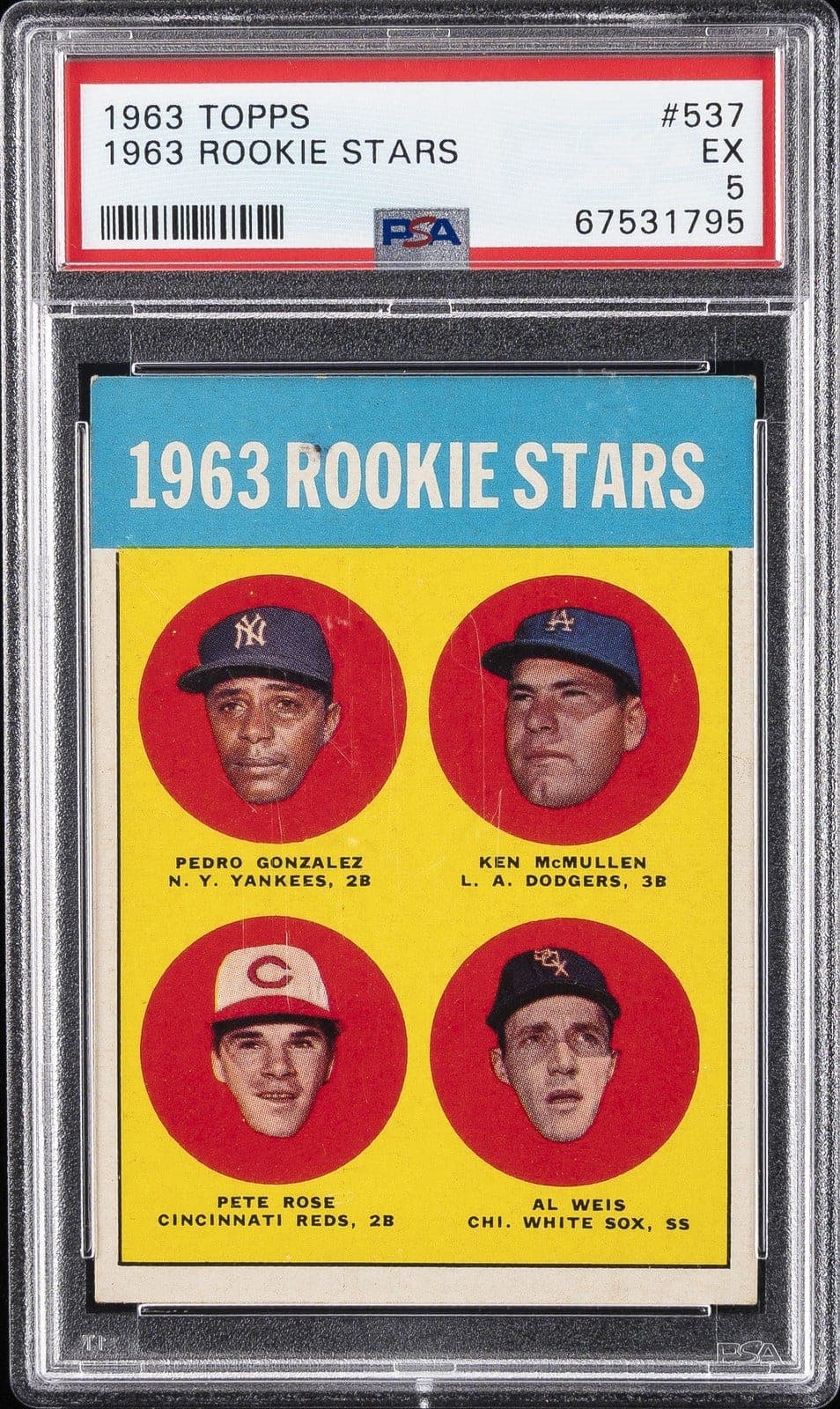
Rose is useful precisely because the second event could not be assumed years ahead. His playing career ended decades earlier, and his Hall of Fame status suddenly became an open question again. That is genuinely new information.
What this means if you are buying
A Hall of Fame induction is usually a weak reason to buy after the fact. If the player is an obvious candidate, the validation is already in the price. The opportunity is where the market may be misjudging the odds of something genuinely uncertain.
Death and unexpected retirement create much larger short-term moves, and the cases here argue against treating those spikes as permanent reratings. Simpson's PSA 7 nearly round-tripped. Mays did not spike at all. Kobe suggests the biggest percentage moves happen in the cheap, liquid cards that can absorb a rush of new buyers, not in established trophy assets.
The 2027 Hall of Fame ballot is the live application. Chase Utley enters at 59.1 percent after a large gain in 2026.12 Buying after an eventual induction means paying once the new information has already arrived.
The question is never whether a milestone is good for a legacy. It is whether the market has already priced it, and where the remaining uncertainty is mispriced.
Notes
- FanGraphs, Jan. 20, 2026, reporting 229 public ballots, about 54 percent of the electorate, ten hours before the BBWAA announcement, with Andruw Jones at 82.5 percent. ↩
- National Baseball Hall of Fame, official 2026 BBWAA results. Jones finished at 78.4 percent and Carlos Beltrán at 84.2 percent. ↩
- MLB and Sports Collectors Daily coverage of Mariano Rivera's unanimous 2019 election and the Topps NOW Hall of Fame issues around it. ↩
- Compiled transaction file for the 1970 Topps O.J. Simpson rookie in PSA 7, fixed at one grade, supplying the April 2024 pre-death sale and the post-death peak. Card Ladder and PSA both place PSA 7 examples back in the high $200s in 2026. ↩
- ESPN, Feb. 2, 2022, citing eBay data: Brady collectible sales up 198 percent, rookie-card sales up 233 percent and rookie searches up 476 percent across Jan. 23 to 29, 2022. ↩
- The football from Brady's apparent final touchdown sold for $518,628 in March 2022; the sale was voided after he announced his return the following day. ↩
- Contemporary hobby reporting on Andrew Luck's 2019 retirement describing a sharp fall in his premium rookie market. ↩
- Julien Pénasse, Luc Renneboog and José Scheinkman on premature artist deaths: prices up 54.7 percent, secondary-market volume up 63.2 percent, with the effect persisting. ↩
- A 1951 Bowman Willie Mays in PSA 8 sold for $186,000 in June 2024 before his death; Heritage sold another PSA 8 for $174,000 in Aug. 2024. ↩
- Chase Utley enters the 2027 Hall of Fame cycle at 59.1 percent after a large gain in support in 2026. ↩
- Month-over-month gains across grades of the 1963 Topps Pete Rose rookie after the May 2025 eligibility change: PSA 8 up 41 percent, PSA 4 up 45 percent, PSA 2 up 52 percent. ↩