
Stop Buying Prospects. Buy Disappointment.
Prospect cards price in the career everyone hopes a young player will have; buyers get the better risk-reward once the first part of that career goes wrong.
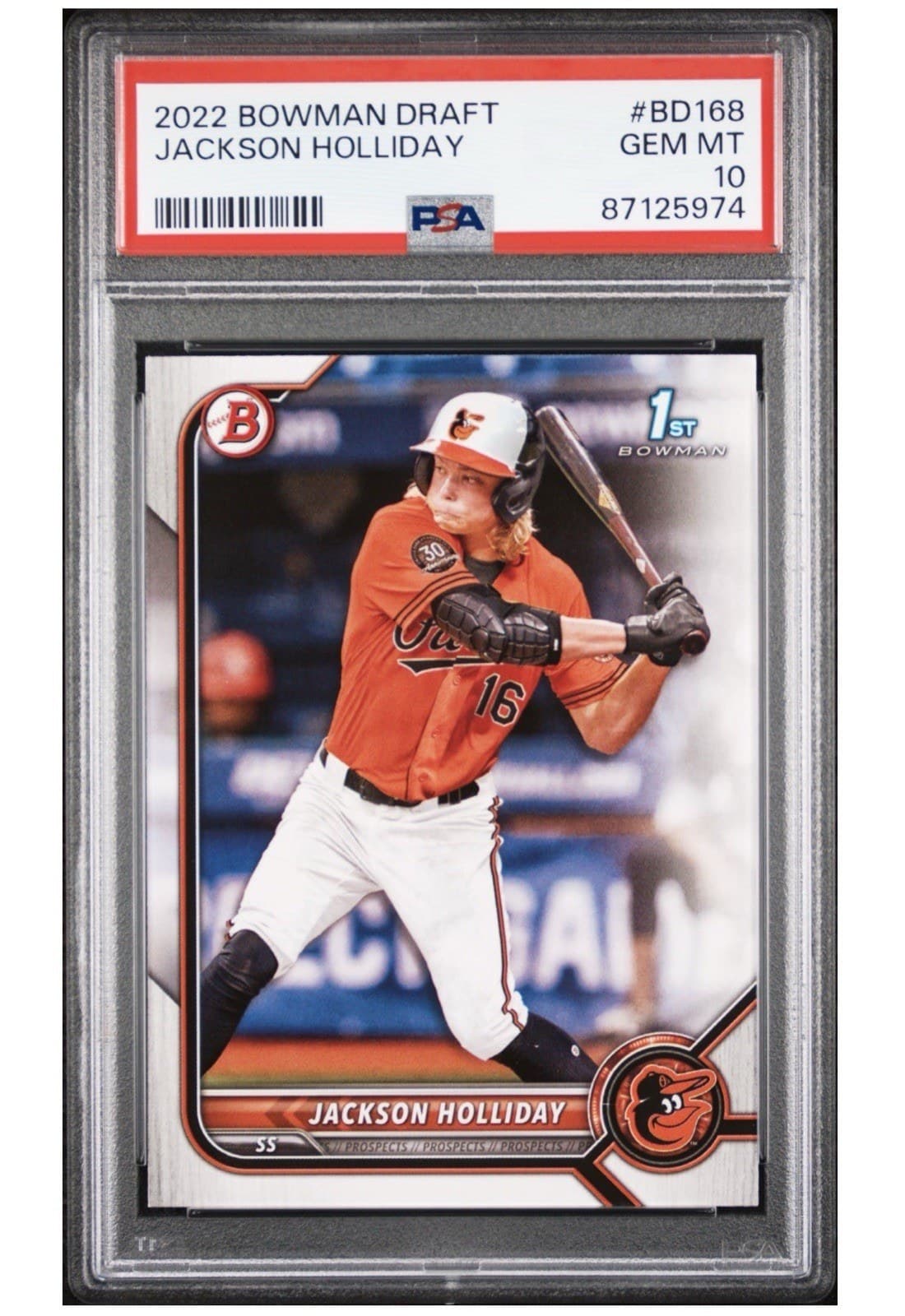
Jackson Holliday entered the major leagues in April 2024 with almost everything a card investor could want. He was the first pick in the 2022 draft, Baseball America's No. 1 prospect, MLB Pipeline's No. 1 prospect and the son of a seven-time All-Star. His 2022 Bowman Draft Chrome Blue Refractor Autograph /150 PSA 10 sold for $4,566 USD on March 28, 2024, $4,950 USD on April 16, 2024, and $5,350 USD on April 19, 2024, nine days after his major-league debut.1
Holliday then went 2-for-34 with 18 strikeouts in his first ten games and was sent back to Triple-A. The interesting part was how differently the baseball and card markets processed the same information. Baseball America kept Holliday at No. 1 in its next Top 100 update, writing that 36 difficult major-league plate appearances and a demotion did not materially change its long-term evaluation. The card market was less patient.23
That same Blue Refractor Autograph PSA 10 most recently sold for $975.60 USD in August 2026, with a PSA 10 population of 56. The regular Bowman Draft Chrome autograph PSA 10 recently sold for $315 USD on August 17, 2026, down 47.5% over the preceding three months.4
Holliday's card market hasn't recovered since. Through late August 2026, the 22-year-old is batting .229/.321/.356 with a 93 OPS+, following a 95 OPS+ season in 2025. He has been substantially better than the player who went 2-for-34, but he has not become the star collectors were already paying for two years ago.5
That is why Holliday is a useful example. At $5,350 USD, his card was priced around an unusually clean development path. At $975.60 USD, the investment case is different. A buyer still needs Holliday to improve, but no longer needs the original superstar outcome to justify the purchase.
That may be one of the better ways to approach prospect investing. Do not pay the highest price when the most optimistic version of the career is still possible. Wait until something goes wrong.
Sold April 19, 2024, nine days after his major-league debut. The high.
Sold in this range in August 2024, after his demotion to Triple-A.
Sold March 2025.
Sold April 2025.
Sold September 2025.
Sold August 13, 2026, the most recent recorded sale, down about 82% from the April 2024 high.
Prospect prices often assume too much, too early
The basic problem with prospect cards is that uncertainty does not always produce a discount. It can produce excitement.
Before a top prospect has established himself, almost every positive catalyst remains ahead. The first call-up, Rookie of the Year campaign, first All-Star selection, MVP season, championship and eventual Hall of Fame discussion are all still available to the imagination. The player has not yet accumulated enough major-league evidence to eliminate many of the best outcomes.
That can make the cards unusually expensive relative to what has been accomplished.
For collectors, the appeal is understandable. Buying early is how someone ends up owning an important card before the player becomes unaffordable. But the investment has an unusual downside: the player can turn out to be quite good and still disappoint his early collectors who bought in early at all-time high.
A prospect card bought at a valuation that assumes superstardom does not necessarily work if the player becomes an ordinary All-Star. The investor is paying not only for talent but for the probability that nearly everything goes right.
Once the player struggles, some of that probability comes out of the price. The better opportunity can emerge when the market lowers its expectations faster than the long-term case deteriorates.
Holliday is a useful test of the idea
Holliday's card history shows how much valuation can be attached to an unproven future.
The Blue /150 PSA 10 sold for more than $4,500 USD before his April 2024 debut, then for $5,350 USD shortly after it. It still sold for $3,075 USD to $3,846 USD in August 2024, after his demotion. The card most recently sold for $975.60 USD in August 2026, per Card Ladder.14
The decline from the April 2024 high is about 82%.
Some of it has been deserved. Holliday has had more than the original ten games to establish himself. The offensive production remains below average. An investor cannot point to his age and assume the original scouting report will eventually prevail.
But the relevant question at the card's August 2026 price is different from the one a buyer faced in April 2024.
At $5,350 USD, Holliday needed to become one of baseball's important young stars for the card to have much room above it. Around the card's $975.60 USD price, a meaningful improvement in his career trajectory could be enough to produce a substantial re-rating. He is still 22, still receiving regular major-league playing time and coming from the same underlying talent base that made him the top prospect in the sport.
The downside has not disappeared. The required upside has become less extreme for his card prices to go up.
Baker Mayfield shows what happens when expectations become too low
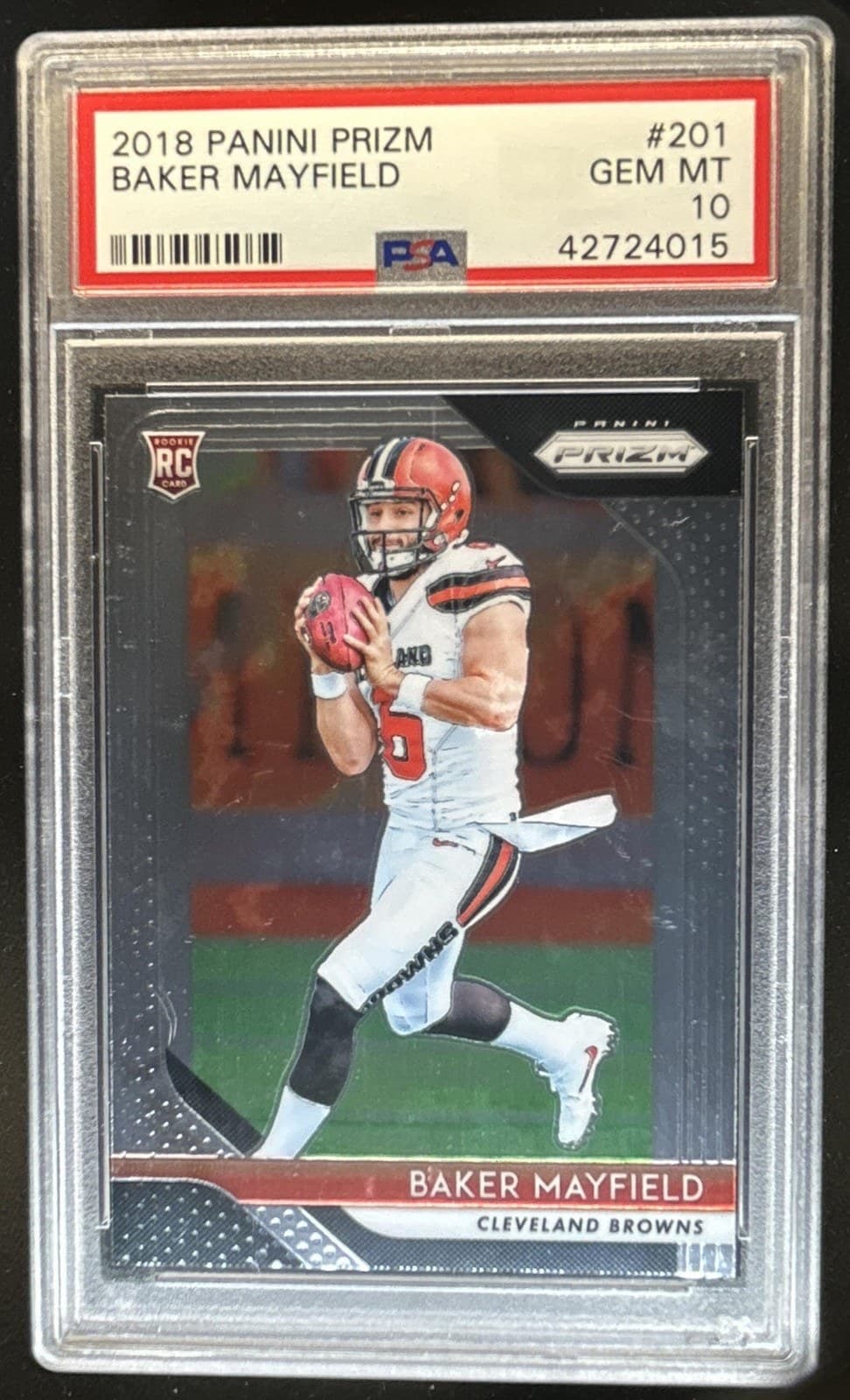
Baker Mayfield was the No. 1 pick in the 2018 NFL Draft and initially had one of the stronger card markets among young quarterbacks. His 2018 Prizm rookie PSA 10 sold for roughly $143 USD to $145 USD in February 2022.6
His career then moved rapidly in the wrong direction. Cleveland traded for Deshaun Watson and sent Mayfield to Carolina. The Panthers struggled, Mayfield lost the starting job and Carolina eventually waived him. He finished the season with the Rams before entering free agency without a clear long-term starting opportunity.
The card market essentially wrote him off. PSA's completed-sales history shows Mayfield Prizm PSA 10s sold for $73 USD in early September 2022, then $46 USD, $30 USD and eventually as little as $20 USD to $26 USD in October 2022.6
Tampa Bay signed Mayfield to a one-year deal worth $4 million USD in 2023 and made him compete for the starting job. He responded with 4,044 passing yards, 28 touchdowns and 10 interceptions, led the Buccaneers to a division title and playoff victory, and finished third in Comeback Player of the Year voting. Tampa subsequently signed him to a three-year, $100 million USD contract.78
His Prizm PSA 10 has recently sold between roughly $69 USD and $99 USD in August 2026, with a population of 993.9
That does not make the card an enormous long-term winner from its original highs. It does demonstrate why the entry point matters.
Someone buying Mayfield at $145 USD in early 2022 needed his status as a franchise quarterback to hold. Someone buying around $20 USD to $30 USD later that year was investing after the market had largely abandoned that assumption. Mayfield did not need to become Patrick Mahomes to make the second purchase work. He only needed to prove that he could still be a successful NFL starter.
The same player represented a different investment outcome depending on when the card was purchased.
Sold in February 2022, before Cleveland traded for Deshaun Watson and dealt Mayfield to Carolina.
Sold in October 2022, after the Panthers waived him and before Tampa Bay signed him.
Recent August 2026 sales, after his 2023 comeback season and $100 million USD contract.
Bryce Young is a more recent version
Carolina selected Bryce Young first overall in 2023. His rookie season produced 2,877 passing yards, 11 touchdowns, 10 interceptions and a 73.7 passer rating. The beginning of his second season didn't fare as well. After an 0-2 start in which Carolina's offense struggled badly, the Panthers benched Young for Andy Dalton in September 2024.10
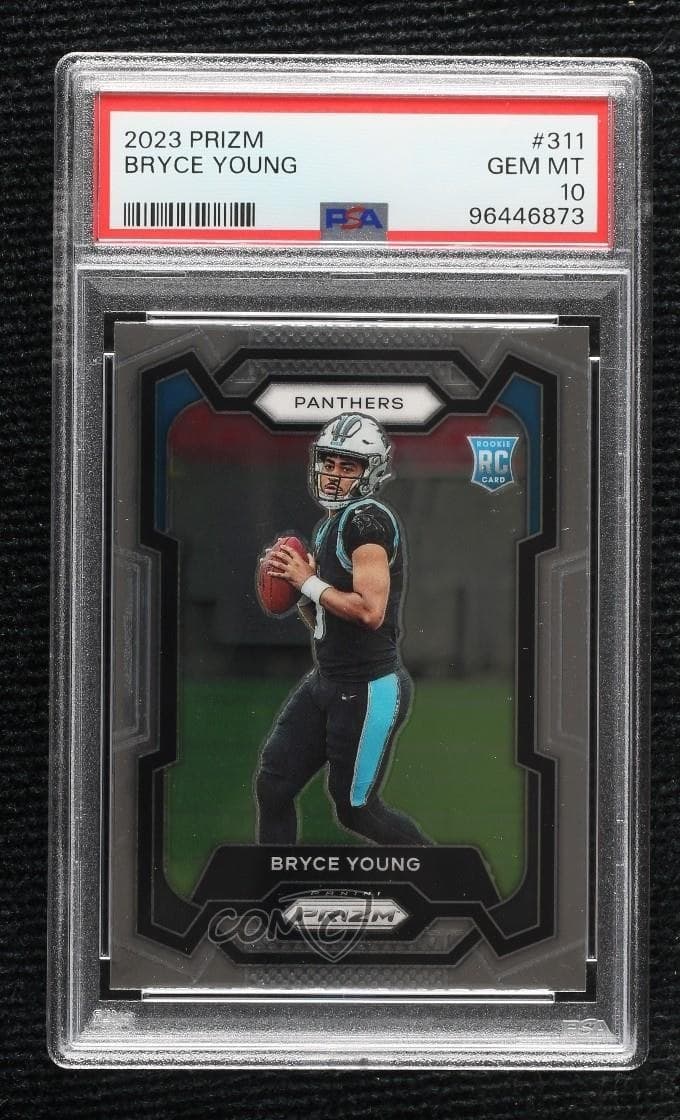
The card market treated the benching as a major reassessment. An SGC 10 copy of Young's 2023 Prizm base rookie had sold for $50 USD in August 2024. After the benching, the card sold for $15.50 USD on September 21, 2024, then $5.50 USD on September 26, 2024, then $4.25 USD on October 13, 2024.11
Young eventually returned to the lineup. His performance improved enough that the Panthers kept him as their starter, and in 2025 he threw for 3,011 yards, 23 touchdowns and 11 interceptions. His 2023 Prizm Silver PSA 10 sold for $162.50 USD on August 23, 2026. The base PSA 10 has recently sold in the $30 USD to $40 USD range.1213
Young has not yet justified the expectations that came with being the first pick in the draft. His career passer rating remains 80.9 through three seasons. By the time his card was selling for a few dollars after the benching, the market no longer required him to become an elite quarterback for sentiment to improve.
The trade became a bet that he was not finished.
That is a materially easier thesis than betting before his rookie year that he would become a superstar.
Buy the struggle, not the decline
The obvious danger with this approach is confusing a lower price with a better investment.
Sometimes the player struggles because the original projection was wrong. Sometimes a quarterback cannot adjust to NFL defenses. Sometimes a baseball prospect's bat does not translate against major-league pitching. Injuries can become chronic rather than temporary. An organization reducing a player's role can reflect information that the card market is only beginning to recognize.
That is why the most attractive disappointment trades are early enough that the upside still exists, but late enough that much of the speculative premium has disappeared. That's always the hardest trade to enter, buying the low, when sentiment is poor or non-existent.
Holliday is interesting because he is 22 rather than 27. Baseball America did not abandon its evaluation after his initial failure. He still has regular major-league playing time. Bryce Young was interesting after the benching because Carolina still controlled him for several years and continued publicly treating the move as part of his development rather than the end of his career. Mayfield had already shown that he could play quarterback successfully in the NFL before his market collapsed.
Those are different situations from buying a former top prospect only because his cards have collapsed.
The investment case needs an identifiable reason that the market may be too pessimistic.
The timing problem
There is also no requirement to buy at the exact bottom.
In fact, trying to do that may introduce unnecessary risk.
A prospect card can fall 50%, appear cheap and then fall another 50%. Holliday's Blue /150 is a good example. It sold for $2,700 USD in March 2025, already roughly half the April 2024 high. The most recent sale is still almost two-thirds below that level.
Waiting for some evidence of stabilization can therefore be rational even if it means missing the lowest possible price.
The ideal trade may occur when the market has already repriced the failure but before a full recovery is obvious. That could mean buying after a prospect returns from the minors and starts making better contact, after a young quarterback regains the starting job, or after an injured player returns and demonstrates that the underlying athletic ability remains.
That approach sacrifices some theoretical upside but reduces the chance of buying a decline that has not finished.
The prospect premium is also a catalyst premium
There is another reason to prefer disappointment to peak hype: many of the easiest catalysts have already been priced into prospect cards.
Before Holliday debuted, collectors knew his promotion was coming. The debut itself was not new information about his talent. It was the realization of an expected event.
The same phenomenon appears in football around the draft and opening week. A quarterback can appreciate because he was selected early, then appreciate again because he won the starting job, all before demonstrating that he can succeed in the NFL.
This creates a strange setup where the card may be most expensive when the least is known.
After a struggle, the relationship reverses. The next positive catalyst usually requires actual evidence. A successful return from Triple-A, better underlying hitting data, improved quarterback play or renewed organizational commitment can change the expected career outcome rather than confirm something the market already anticipated.
That makes the post-hype period potentially more useful for investors who care about price relative to evidence.
What I would watch
- Jackson Holliday 2022 Bowman Draft Chrome Autographs. The Blue /150 PSA 10 is the cleanest example of the thesis because the price history is so dramatic: $5,350 USD around his debut versus $975.60 USD in August 2026. I would not buy it solely because it has fallen 82%. His current major-league production still leaves real risk that the original upside never materializes. But at 22, the card now offers a different risk-reward than it did when collectors were paying $5,350 USD before knowing whether he could hit major-league pitching.
- Bryce Young 2023 Prizm Silver PSA 10. The Prizm Silver PSA 10 sold for $162.50 USD on August 23, 2026. The market has moved past the period when Young was valued primarily as a No. 1 pick, but it has not priced him as a proven franchise quarterback either. That leaves upside if his 2025 improvement continues, while his three-year statistical record explains why the card remains far below the levels associated with elite young quarterbacks.
- The next Baker Mayfield situation. Mayfield is more useful as a model than as a current recommendation. The attractive setup was that a former No. 1 pick who had already demonstrated NFL-level ability was being priced as though he had almost no chance of becoming a productive starter again.
Across sports, I would look for that combination: elite original pedigree, a large collapse in expectations, continued opportunity and some objective reason to believe the underlying talent has not disappeared.
The investment case
Prospect investing tends to reward the most exciting story with the highest valuation. That may be backwards from an investment perspective.
Before the struggle, the market can price a player for his ceiling. After the struggle, it begins pricing the probability that the ceiling will never be reached. If that adjustment is too severe, the investor gets a much lower entry price without necessarily accepting a proportionate reduction in long-term upside.
This is a strategy of buying early disappointment, not of buying failed prospects. The market may be treating temporary or incomplete evidence as a final verdict.
There is still substantial risk. Holliday may never become a star. Bryce Young may remain an average or below-average NFL quarterback. The next former top prospect may continue declining after the apparently attractive entry point.
But that risk exists in the prospect card at the top too. The difference is that the buyer at peak hype is paying as though much of it does not.
Buying after disappointment at least puts the uncertainty back into the price.
Conclusion
The hobby naturally prefers the player before anything has gone wrong. That is when the upside is easiest to imagine and the card is easiest to sell.
It is also often when the buyer is being asked to pay the most for that possibility.
Jackson Holliday's Blue Bowman autograph sold for $5,350 after 1.5 weeks in the majors. It now sells for less than $1,000 after two-plus seasons of evidence have made his future considerably less certain. Baker Mayfield's Prizm rookie fell into the $20s when the NFL appeared to have moved on from him, then recovered after he rebuilt his career. Bryce Young's cards collapsed when he was benched, then partially recovered when his performance improved.
None of those examples means that struggling young players are automatically undervalued.
They show something more useful: the price of uncertainty changes dramatically depending on whether collectors are imagining the upside or reacting to the downside.
The better trade may be to let someone else pay for the perfect career. Then decide whether the imperfect one has become too cheap.
Notes
- SportsCardsPro, 2022 Bowman Draft Chrome Jackson Holliday Blue Refractor Autograph /150. PSA 10 sales include $4,566 USD on March 28, 2024, $4,950 USD on April 16, 2024 and $5,350 USD on April 19, 2024. sportscardspro.com ↩
- MLB, April 26, 2024. Baltimore optioned Holliday after he went 2-for-34 in his first ten major-league games. mlb.com ↩
- Baseball America, May 2, 2024. Holliday remained No. 1 in its Top 100 after his demotion; the publication said the first 36 major-league plate appearances did not materially change its long-term assessment. baseballamerica.com ↩
- Card Ladder. Holliday's Blue /150 PSA 10 last sold for $975.60 USD on August 13, 2026, with a population of 56. His regular Bowman Draft Chrome autograph PSA 10 sold for $315 USD on August 17, 2026 and was down 47.5% over the preceding three months. cardladder.com ↩
- Baseball-Reference. Holliday is batting .229/.321/.356 with a 93 OPS+ in 2026 and has a career OPS+ of 89 through late August. baseball-reference.com ↩
- PSA CardFacts, 2018 Prizm Baker Mayfield #201. PSA 10 sales included $143 USD to $145 USD in February 2022 and multiple October 2022 transactions between $20 USD and $30 USD. psacard.com ↩
- Tampa Bay Buccaneers. Mayfield threw for 4,044 yards, 28 touchdowns and 10 interceptions in 2023 and led Tampa Bay to the NFC South title. buccaneers.com ↩
- ESPN. Tampa Bay signed Mayfield to a three-year, $100 million USD contract in March 2024 after his comeback season. espn.com ↩
- PSA and Card Ladder. Recent August 2026 sales of Mayfield's 2018 Prizm PSA 10 ranged from roughly $69 USD to $99 USD; PSA lists a population of 993. psacard.com ↩
- Carolina Panthers. The Panthers benched Bryce Young for Andy Dalton on September 16, 2024, after an 0-2 start. panthers.com ↩
- SportsCardsPro. Bryce Young's 2023 Prizm base rookie SGC 10 sold for $50 USD in August 2024, then $15.50 USD on September 21, 2024, $5.50 USD on September 26, 2024 and $4.25 USD on October 13, 2024. sportscardspro.com ↩
- NFL and Carolina Panthers. Young threw for 3,011 yards, 23 touchdowns and 11 interceptions in 2025 after returning from his 2024 benching. nfl.com ↩
- Card Ladder. Young's 2023 Prizm Silver PSA 10 sold for $162.50 USD on August 23, 2026, with a population of 1,621 and 85 sales over the preceding three months. cardladder.com ↩