How to Tell If the Old Trading Cards in Your Closet Are Worth Anything
A 1st Edition Jungle Snorlax just sold for $180,000. Here's what to pull from an old card box before the holidays and how to find what a card sold for.
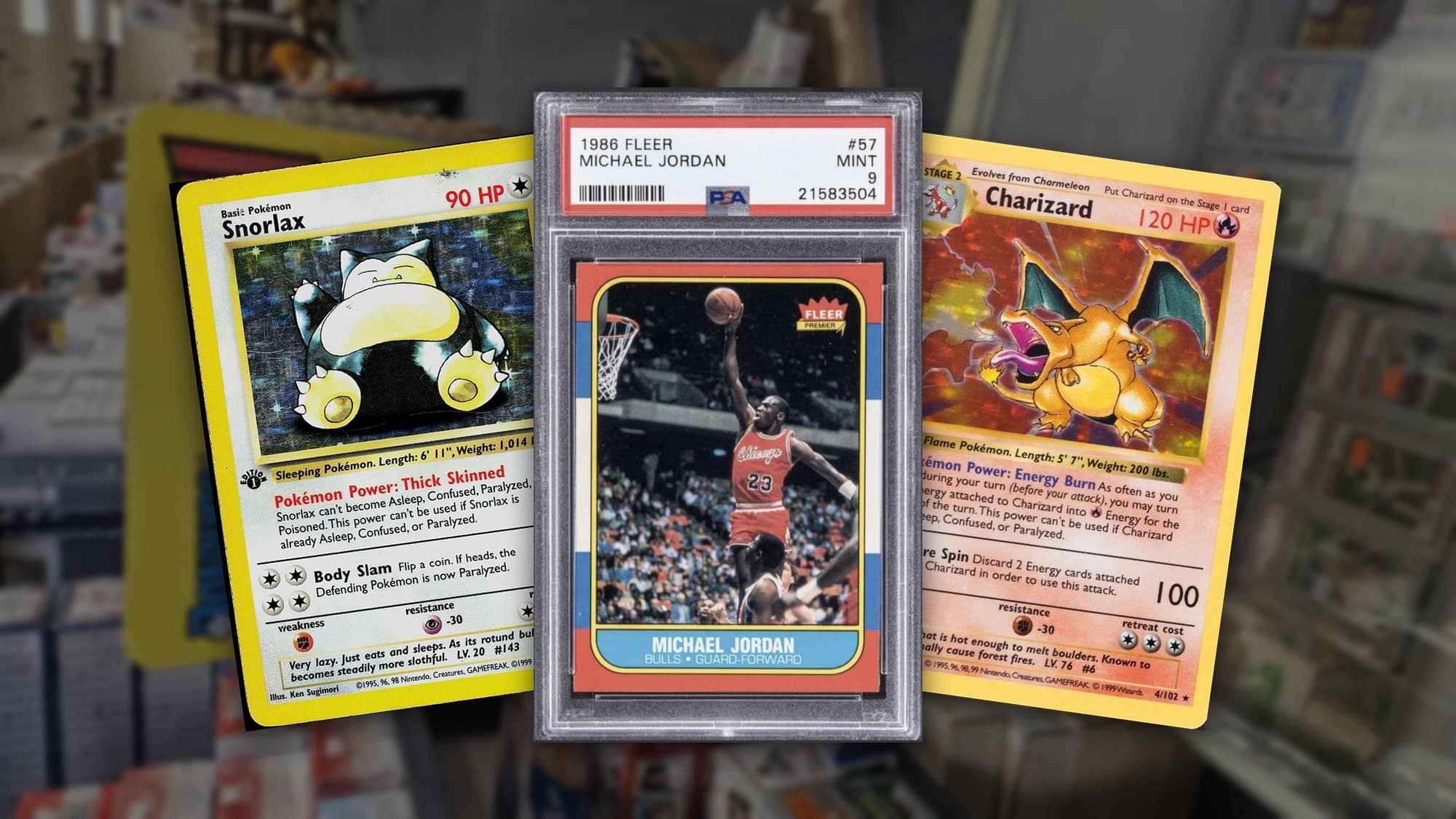
A 1st Edition Jungle Snorlax in a PSA 10 sold for $180,000 at Fanatics Collect on Oct. 18. Six days earlier, two 1st Edition Base Set Charizards in PSA 9 sold for $124,950 and $125,000 on eBay. Charizard is still the bigger name, but in the top grade a Snorlax outsold those 9s. If you're about to haul a childhood card box to a yard sale or a thrift store this holiday season, check the grade on a card before you judge it by the name.
Those numbers are grades. PSA, the biggest card grading company, scores a card's condition from 1 to 10 and seals it in a plastic case with the grade on the label. A card nobody has graded yet is called raw. One step on that scale can be worth more than the name on the card. That's how a Snorlax in a 10 outsold Charizards in a 9.
Most of what sits in an old box is worth little, but a few cards in it can pay for the whole holiday. Here's what I'd look for before anything leaves the house.
Which old cards are worth checking first?
Start with the Pokémon cards from 1999 and 2000. The ones to look for carry a small black "Edition 1" stamp just below the bottom left corner of the picture. The next printing of Base Set, the first English Pokémon set, is called shadowless. It has no stamp and no drop shadow along the right edge of the picture frame. A shadowless Charizard in a PSA 8 still sells around $6,199.
Then look at sports cards from before 1980 and rookie cards of players who made the Hall of Fame. A 1986 Fleer Michael Jordan rookie in a PSA 8 has sold for around $16,300 since late September, while a PSA 5 has sold for around $8,385 since early September.
Non-sport cards deserve a look too. I still think 1990s Marvel cards are underpriced next to sports cards from the same years.
Why is most of the box worth so little?
Card companies printed so many cards from about 1987 to 1993 that collectors call those years the junk wax era. Even a Michael Jordan from those years isn't a lottery ticket. A 1990 Hoops Jordan #65 in a PSA 9 has sold for $52 to $118 since late July.
A PSA 10 of that same Jordan has sold for $968 to $1,125 in October. Grading a raw copy only pays if it comes back a 10, since PSA's cheapest service right now costs $60 a card.
What condition problems kill a card's value?
Condition is most of the price and where most folks looking in their attic get disappointed, real quick. A 1st Edition Jungle Flareon shows how steep the ladder gets:
- PSA 10: sold for $25,800 at Fanatics Collect on Oct. 18
- PSA 9: sells around $2,105 this fall
- PSA 8: sells around $568 this fall
Creases, stains, bent corners and edges that have been cut down all pull a card down that ladder. Don't wipe, flatten or trim a card to fix it. Graders look for exactly that. PSA gives an altered card no number grade at all.
What should you photograph before getting a card valued?
Shoot the front and back straight on in daylight, then take close-ups of all four corners. Write down the year, set name and card number printed on the back, because one player can have a dozen cards from the same year. If the card is already in a graded case, photograph the label so the certification number shows.
Why a Best Offer sale can fool you
Most people look up a card's sold price on eBay and trust it. A Best Offer listing lets a buyer send the seller a lower price instead of paying what's listed. Best Offer sales are where that goes wrong, because the listed price is only what the seller asked for, it's not what a buyer actually paid.
I saw it this month on a 1st Edition Dark Dragonite in a PSA 9. The seller listed it at $3,600 and accepted a Best Offer of $3,060.
We're building out card pages right now on CardWire, stay tuned and you will be able to get all of this information right here on the site. Until then, feel free to email me directly at editor@cardwire.com and I'd be more than happy to help you out!
When should you get a card graded instead of appraised?
For cards, skip the appraisal. If a card could sell for a few hundred dollars raw, get it graded by PSA or another major grader, because buyers primarily pay for the PSA grade number on the label. Scarcity in the top grade is what drives the biggest prices. PSA had graded only 76 Jungle Snorlax 10s as of Oct. 22.
What scams should first-time sellers watch for?
I'd check the most famous cards first because those are the ones worth faking with a reprint or a fake grading case. Look up any certification number on PSA's website and make sure the card in the photo matches the card in the case. PSA also deactivated the certification numbers on the 6,451 graded items stolen from a FedEx carrier truck after pickup at its Santa Ana, California, facility this month. A cert that won't come up is a reason to walk away. Also make sure you didn't fat finger a number while you're typing it in.
If someone offers to take the whole box on the spot, go through it first. Pull anything with a 1st Edition stamp, anything shadowless, any Hall of Fame rookie and anything already in a graded case. It'll be worth your time to review what you have first!