Letter to Congress on Trading Card Taxes
Photos: Architect of the Capitol; Heritage Auctions, HA.com
A card you've held for years can be taxed at up to 28%, while a card you sell at a loss usually earns no write-off. Sign our letter asking the House Ways and Means Committee and the Senate Finance Committee to change both rules. We send it in November.
READ AND SIGN THE LETTER TO CONGRESS
The full case: The Tax Code Punishes Card Collectors. Here's How to Fight Back.
What the letter asks Congress to do
- Equalize long-term investment gains. Trading cards held for investment should qualify for the same preferential long-term capital gains rates generally available to other capital assets.
- Permit limited gain-loss netting for collectors. Congress should establish a reasonable mechanism for recognizing legitimate trading card losses.
- Provide trading-card-specific certainty. Congress should provide clear rules specifically addressing trading cards.
Read the letter
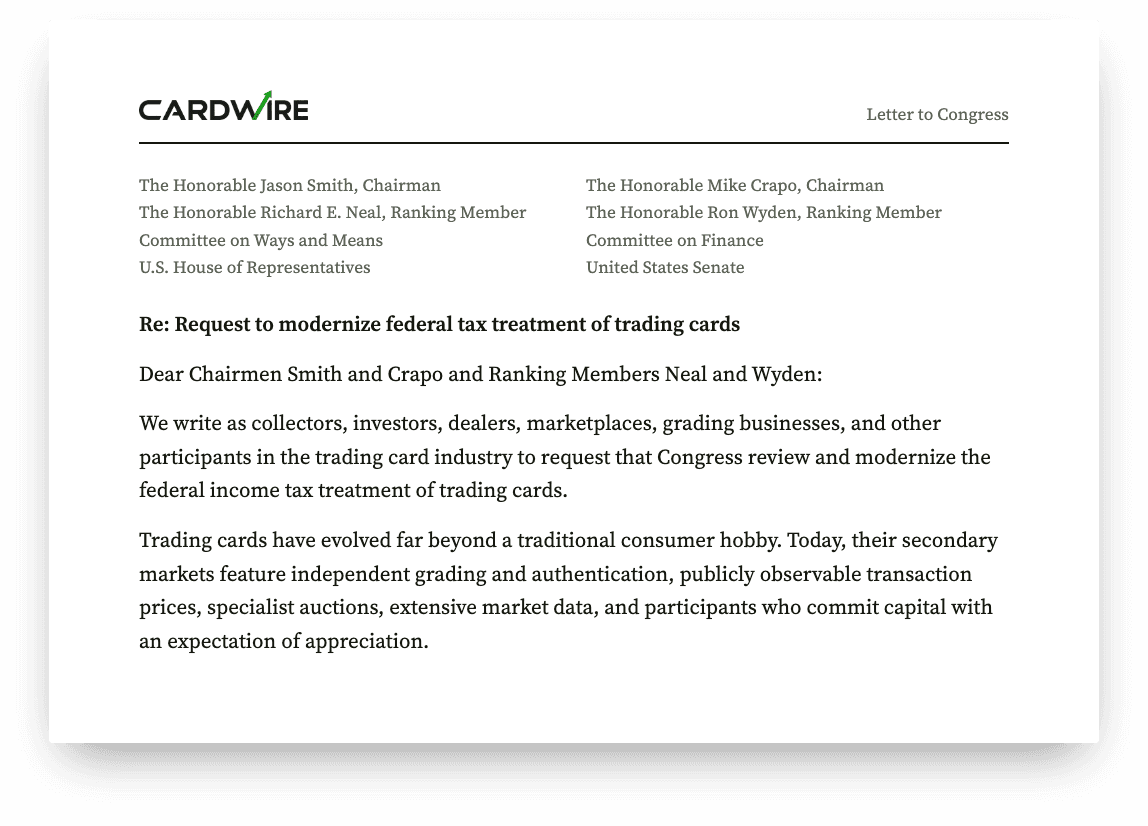
The Honorable Jason Smith, Chairman | The Honorable Mike Crapo, Chairman |
|---|
Re: Request to modernize federal tax treatment of trading cards
Dear Chairmen Smith and Crapo and Ranking Members Neal and Wyden:
We write as collectors, investors, dealers, marketplaces, grading businesses, and other participants in the trading card industry to request that Congress review and modernize the federal income tax treatment of trading cards. CardWire has organized this letter to highlight how current rules can produce different outcomes for economically similar transactions and to propose a practical framework for reform.
Trading cards have evolved far beyond a traditional consumer hobby. Today, their secondary markets feature independent grading and authentication, publicly observable transaction prices, specialist auctions, extensive market data, and participants who commit capital with an expectation of appreciation. Many people acquire cards for both personal enjoyment and investment. Tax law should recognize that combination without creating unnecessary uncertainty or inconsistent results.
The present framework raises two concerns. First, section 1(h) of the Internal Revenue Code imposes a maximum 28% federal rate on certain long-term collectibles gains rather than the 20% maximum generally applicable to other long-term capital gains. Although trading cards are not expressly named in the collectible definition cross-referenced in section 408(m), they are frequently analyzed under that framework, creating both potential disparity and uncertainty. Second, section 165 generally disallows losses on personal-use property, even though gains on sales of that property remain taxable. Investment property losses can qualify for capital-loss treatment under existing law, but mixed personal and investment purposes make the distinction especially challenging for card owners.
For example, an individual who sells one personally held card for a $5,000 gain and another for a $5,000 loss may owe tax on the gain without receiving an offsetting deduction for the loss, despite breaking even economically. That result is particularly difficult to explain to ordinary participants who buy, hold, and resell cards in an established market.
We respectfully request that Congress consider the following targeted reforms:
- Equalize long-term investment gains. Clarify that qualifying trading cards held as capital investments are subject to the ordinary preferential long-term capital gains rate structure, rather than a special collectibles maximum rate.
- Permit limited gain-loss netting for collectors. Create a carefully defined election or safe harbor allowing substantiated losses on arm's-length sales of trading cards to offset gains from trading card sales, with appropriate cost-basis substantiation, anti-abuse rules, and limitations preventing deductions against unrelated ordinary income.
- Provide trading-card-specific certainty. Clarify the federal tax classification of trading cards and provide administrable rules for investment intent, basis documentation, marketplace reporting, and the treatment of occasional collectors as distinguished from dealers.
We recognize that any change must address revenue consequences, compliance, and safeguards against converting personal consumption into deductible losses. Our request is not for a blanket tax exemption. It is for an examination of whether the current framework appropriately reflects a substantial secondary market in which individuals make real investments and incur real financial gains and losses.
We ask the Committees to consider hearings, staff discussions, or bipartisan legislative proposals addressing these concerns. CardWire and the undersigned would welcome the opportunity to provide examples, market information, and further input as you evaluate potential reforms.
Respectfully,
CardWire
On behalf of the undersigned collectors, investors, and trading card industry participants
Signatories:
READ AND SIGN THE LETTER TO CONGRESS
Questions
Who sees my name? Congress gets your full name, your state and any shop or company you add. Your email stays with CardWire.
When does the letter go to Congress? We'll send it to the House Ways and Means Committee and the Senate Finance Committee in November, with every signer listed. We'll report on CardWire when it's sent and when either committee answers.
Does signing cost anything or sign me up for emails? Signing is free. We only email you if you tick the box.
Can I take my name off? Yes, until the letter is sent. Email editor@cardwire.com and we'll take it off.
Is this tax advice? It's general information about federal tax law. Talk to a tax professional about your own sales.