The Tax Code Punishes Card Collectors. Here’s How to Fight Back.
Trading cards have become legitimate investment assets, but federal tax law can subject collectors to higher taxes on gains while refusing to recognize their losses. CardWire is organizing an effort to ask Congress to change the rules.
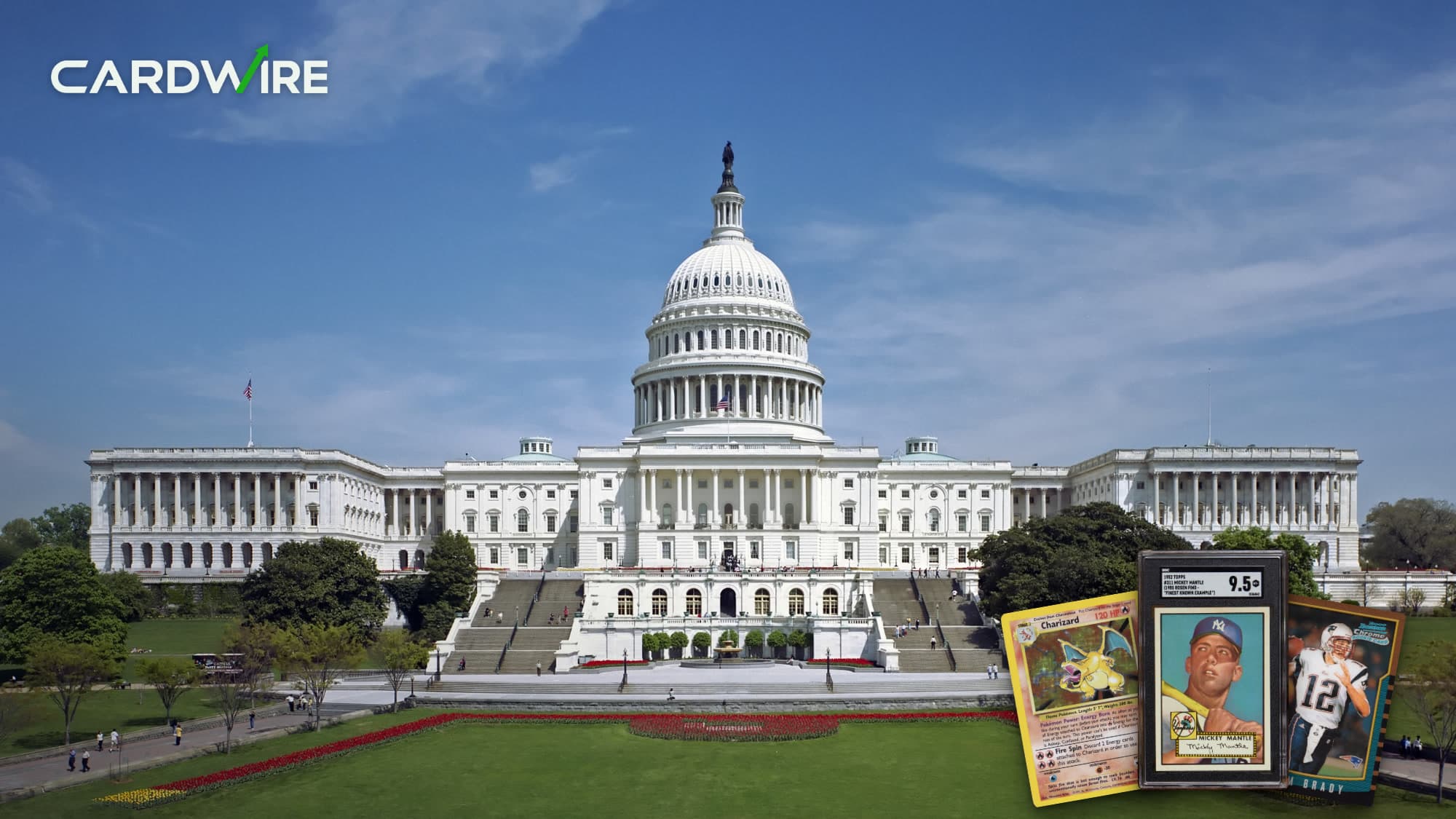
READ AND SIGN THE LETTER TO CONGRESS
Imagine buying two baseball cards for $5,000 each. The first is a rookie card of a promising young player who becomes a superstar. Five years later, you sell it for $15,000, realizing a $10,000 profit. The second player's career doesn't work out. His market collapses, and you eventually sell his card for $500, taking a $4,500 loss.
You spent $10,000 and recovered $15,500. Your actual profit was $5,500. But depending on how those cards were held, the IRS may calculate your taxable income very differently. If the cards were part of a personal collection, the entire $10,000 gain is taxable, while the $4,500 loss generally cannot be deducted. And depending on how the winning card is classified, that gain could be subject to a federal long-term capital gains tax rate as high as 28%, rather than the 20% maximum generally applicable to long-term gains on stocks.

The result is a tax system that can impose significantly higher rates on profitable card sales while refusing to recognize losses from unsuccessful ones. Although losses on cards genuinely held for investment may be deductible under existing law, the distinction between collecting and investing is not always obvious, particularly in a market where people routinely purchase cards for both personal enjoyment and financial appreciation.
As trading cards increasingly become a serious alternative asset class, these distinctions are becoming harder to justify. The hobby has developed the infrastructure of an investment market, but its participants can still face tax rules that were never designed with the modern card economy in mind.
The Tax Code Hasn't Kept Up With the Hobby
For decades, trading cards were primarily understood as collectibles. People purchased them to celebrate their favorite players, complete sets, or own a small piece of sports history. Although certain cards appreciated considerably in value, financial returns were generally secondary to the enjoyment of collecting.
That characterization no longer captures the entire market. Today, collectors analyze historical sales, monitor population reports, compare grading outcomes, track player performance, and build portfolios around cards they believe will appreciate. Professional grading companies authenticate and evaluate cards, auction houses facilitate multimillion-dollar transactions, and online marketplaces allow buyers and sellers to transact across the world. Financial data that was once inaccessible is now routinely available to anyone with an internet connection.
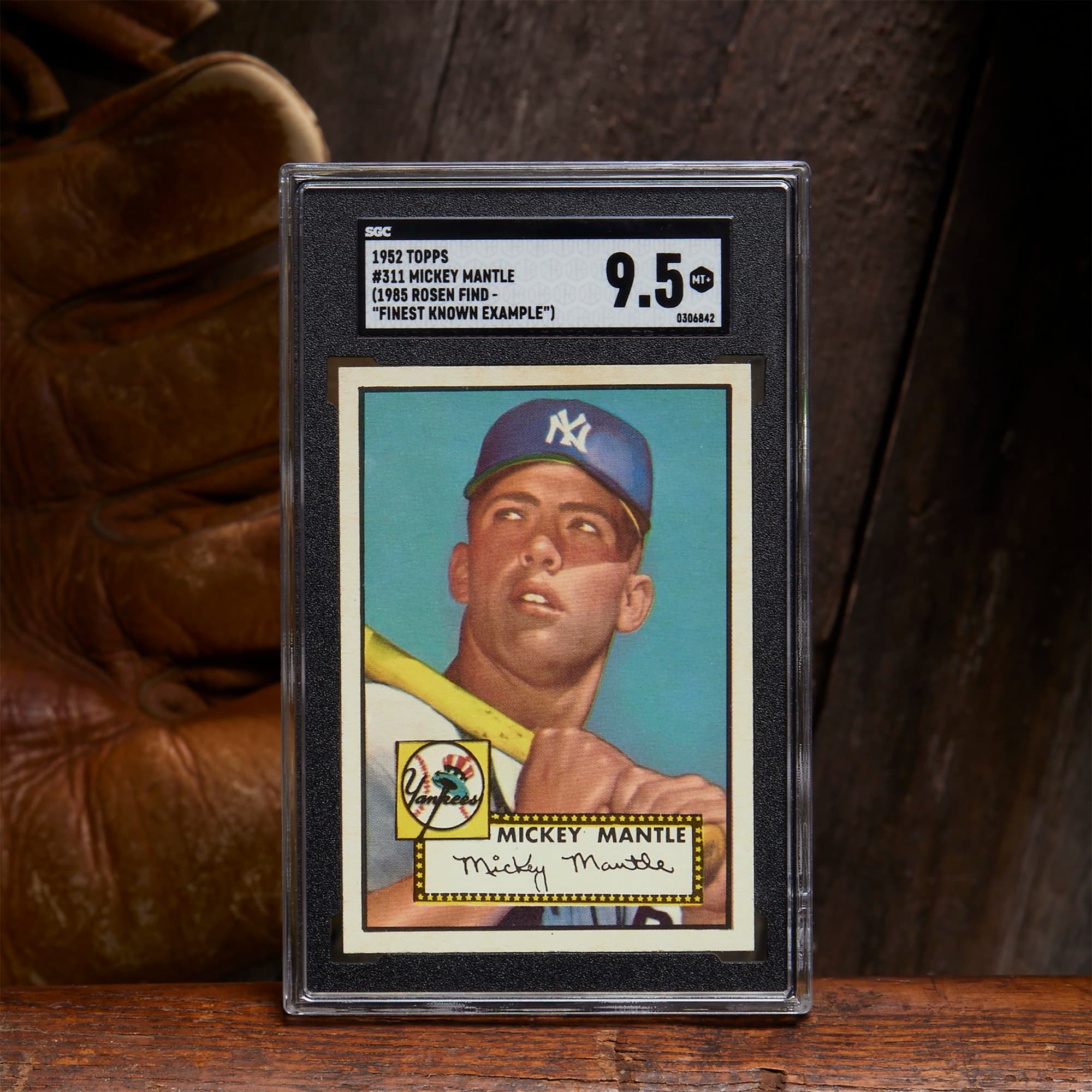
A collector considering whether to purchase a $10,000 rookie card may evaluate scarcity, liquidity, historical price movements, comparable transactions, and future demand. These are fundamentally investment considerations, even if the collector also enjoys owning the card. Indeed, many participants in the hobby now approach their collections as portfolios, buying and selling individual cards based on their assessments of future value.

None of this means that trading cards are identical to stocks or bonds. They are speculative assets whose prices can be influenced by player performance, consumer sentiment, and changing tastes. But people also invest in commodities, cryptocurrencies, art, and other assets that do not generate traditional earnings. An asset does not cease to be an investment simply because its owner enjoys possessing it.
The problem is that the tax code continues to draw distinctions that can be particularly unfavorable for people who participate in both sides of the trading card market: collecting and investing.
The 28% Problem: Higher Taxes on Winning Cards
Under federal tax law, most investments held for more than one year qualify for preferential long-term capital gains rates of 0%, 15%, or 20%, depending on the taxpayer's income. These lower rates have long been justified as a way to encourage investment and account for the different economic characteristics of long-term capital gains.
Collectibles receive different treatment. Section 1(h) of the Internal Revenue Code establishes a special maximum federal tax rate of 28% for certain gains from collectibles, a category that includes assets such as artwork, antiques, stamps, coins, and precious metals. Trading cards are not expressly identified in the statutory list, but they are commonly treated by tax professionals as falling within the collectibles framework. The absence of an explicit reference to trading cards also leaves an important classification question that Congress could resolve.
The financial consequences can be substantial. Consider two investors who each realize a $100,000 gain after holding an asset for more than one year. The first investor sells shares of stock. Assuming the applicable 20% federal capital gains rate, the resulting tax is $20,000. The second sells a rare baseball card. If the collectible gains rules apply and the investor is subject to the maximum 28% rate, the federal tax increases to $28,000.
That's $8,000 in additional federal taxes on an identical economic gain, before considering any applicable net investment income tax or state taxes. The 28% rate is a maximum rather than a flat rate that applies to every collector, but for higher-income investors, the disparity is meaningful.

It is difficult to explain why an individual who risks $100,000 purchasing shares of a speculative company should necessarily receive more favorable long-term capital gains treatment than someone who risks the same amount purchasing a rare trading card. Both have committed capital, assumed the possibility of loss, and ultimately realized a profit from the appreciation of an asset.
The distinction may have made more sense when collectibles were predominantly viewed as personal possessions or luxury goods rather than instruments of investment. But that historical framework is increasingly disconnected from the way trading cards are purchased, valued, and traded today.
The Bigger Problem: What Happens When You Lose?
Higher tax rates on gains are only part of the issue. For ordinary collectors, the treatment of losses can produce an even more frustrating result.
Federal tax law generally does not allow taxpayers to deduct losses on property held for personal use. This principle is understandable when applied to ordinary consumer purchases. Someone who buys a television for $2,000 and sells it several years later for $200 has not necessarily incurred an investment loss. They purchased the television to use it, and its declining value reflects consumption rather than an unsuccessful investment.
Trading cards occupy a less obvious category. Many collectors purchase cards because they enjoy the hobby, but they also expect those cards to retain or increase their value. They evaluate market conditions, identify players they believe are undervalued, and sell cards to finance other purchases. The same card may simultaneously be a cherished collectible and an asset purchased with the expectation of earning a return.

Zion Williamson's 2019 Prizm rookie, #248. A PSA 10 sold for $1,109 on eBay on Dec. 23, 2020. Another sold for $27 on Oct. 13, 2026.
Consider someone who purchases ten cards for $1,000 each. Five appreciate in value and are eventually sold for $2,000 apiece, generating $5,000 in gains. The remaining five decline in value and are eventually sold at a total loss of $5,000.
Economically, the collector has broken even. But if the cards were held for personal use, the government generally recognizes the $5,000 in gains while refusing to allow a deduction for the corresponding $5,000 in losses. The collector can therefore owe taxes despite having made no overall profit.
The treatment is different for cards genuinely acquired and held as investments. Under existing federal law, qualifying investment losses generally can offset capital gains, subject to the ordinary limitations on capital-loss deductions. Professional dealers who buy and sell cards as inventory are governed by another set of rules.
These distinctions mean that the tax consequences of buying and selling the same card can depend significantly on why the owner acquired it and how it was held. Someone purchasing cards exclusively for financial appreciation may have a stronger basis for claiming investment treatment than someone whose collection is primarily personal. But the modern hobby rarely fits neatly into either category, and the tax law offers relatively little card-specific guidance for determining where that line should be drawn.
The practical problem is that collectors may face substantial uncertainty about how their activities will be characterized. They may also find themselves paying taxes on profitable sales without being able to recognize economically comparable losses. For participants who approach the hobby as both a passion and an investment, the result can be an unusually unfavorable combination of tax consequences.
READ AND SIGN THE LETTER TO CONGRESS
Trading Cards Have Become Investable Assets
The argument for reform does not require treating every baseball card purchase as a financial investment. Millions of people collect cards primarily for enjoyment, and many purchases will never produce an economic return. Trading cards can be speculative, illiquid, and highly sensitive to changing consumer preferences, which makes them fundamentally different from many traditional financial assets.

Cooper Flagg's 2025-26 Topps Chrome rookie, #251.
But those characteristics do not justify ignoring the investment activity that undeniably exists within the hobby. An investor who purchases cryptocurrency can generally recognize capital losses when the asset declines in value and the loss is realized. Someone who buys speculative technology stocks can do the same. Investors in real estate and other alternative assets also operate under tax frameworks that recognize both gains and qualifying losses, even if the specific rules vary by asset class.
Trading cards have developed many of the same characteristics that define other investable assets. They have observable secondary-market prices, established transaction venues, independent authentication and grading services, historical sales data, and increasingly sophisticated market participants. Buyers can construct diversified portfolios, evaluate risk, and make decisions about when to enter or exit positions.
The fact that these assets also carry cultural or sentimental value should not necessarily deprive their owners of the tax benefits associated with investment activity. A collector who purchases a rare rookie card because they believe it is undervalued has assumed a financial risk, regardless of whether they also admire the player pictured on it.
The better approach is to recognize that trading cards can function as both collectibles and investments, and to develop tax rules that account for that dual character rather than relying on distinctions that were established for a very different market.
What Congress Should Change
There is a reasonable case for Congress to revisit the federal tax treatment of trading cards. Any reform would require careful consideration of how to distinguish genuine investment activity from personal consumption, but that challenge should not prevent lawmakers from evaluating whether the current framework remains appropriate.
CardWire believes the discussion should focus on three specific changes.

First, trading cards held for investment should qualify for the same preferential long-term capital gains rates generally available to other capital assets. Congress should clarify the classification of trading cards and consider excluding qualifying trading card investments from the special 28% collectibles rate. A collector who purchases a card as an investment, holds it for several years, and eventually sells it at a profit should not face a higher maximum federal capital gains rate solely because the underlying asset happens to be a trading card.
Second, Congress should establish a reasonable mechanism for recognizing legitimate trading card losses. The existing prohibition on deducting personal-use losses serves an important purpose, and an overly broad exception could invite abuse. But a narrowly tailored rule could permit documented losses from card sales to offset gains from other card sales, even where the owner also enjoyed the cards as collectibles. Such an approach could preserve the broader rules governing personal property while recognizing that secondary-market trading activity involves genuine financial risk.
Third, Congress should provide clear rules specifically addressing trading cards. Collectors should not have to determine their federal tax obligations by applying statutory language developed for artwork, antiques, and other traditional collectibles to a market with very different characteristics. Clear guidance about classification, investment intent, cost basis, and the treatment of gains and losses would benefit collectors, marketplaces, and tax administrators alike.
These changes would not eliminate taxes on profitable card sales, nor would they necessarily make every losing purchase deductible. Instead, they would create a more predictable framework that treats investment activity consistently and acknowledges the economic realities of the modern trading card market.
CardWire Is Asking Congress to Change the Law
The trading card industry has spent the past decade building an increasingly sophisticated marketplace, complete with professional grading, authentication services, pricing databases, global auctions, and specialized investment platforms. What the industry has not developed to the same extent is a coordinated voice in Washington on the tax issues affecting collectors and investors.

CardWire is taking a first step toward changing that. We have prepared a letter to the House Committee on Ways and Means and the Senate Committee on Finance asking Congress to reconsider the federal tax treatment of trading cards. The letter calls for three reforms: applying ordinary long-term capital gains rates to qualifying trading card investments, establishing a reasonable mechanism for recognizing documented card-sale losses, and clarifying the tax rules governing the trading card market.
We are inviting collectors, investors, dealers, grading companies, auction houses, marketplaces, and other industry participants to sign the letter. Our goal is to demonstrate that this issue affects a broad community of people who buy, sell, and invest in cards, and that there is meaningful support for a tax framework that better reflects how the modern market operates.
The letter will be submitted to the congressional tax-writing committees with the names of its signatories. Participants can review the full text before signing, and CardWire will provide updates on the initiative as it develops. We hope to build a coalition that includes both individual collectors and established industry businesses, presenting lawmakers with a unified request for a more modern approach to trading card taxation.
There are legitimate policy questions that Congress would need to consider. Lawmakers would have to evaluate the budgetary effects of any proposed change, determine how qualifying transactions should be documented, and establish safeguards to distinguish bona fide investment losses from ordinary personal expenditures. Those issues are important, and meaningful reform will require more than simply declaring that all collectibles should be treated like stocks.
But the existence of complicated questions is not a reason to leave an outdated or uncertain system untouched. The trading card market has evolved substantially, and the industry should have an opportunity to explain how the current rules affect its participants and what a more appropriate framework might look like.
Read the Letter. Add Your Signature.
CardWire is asking collectors and industry participants to sign our letter to Congress calling for modernized federal tax treatment of trading cards. Whether you collect occasionally, actively trade cards, manage a substantial portfolio, or operate a business within the industry, your signature can help demonstrate the breadth of participation in this market.
The objective is not to secure a blanket tax exemption for trading cards. It is to ask Congress to recognize that cards can function as investment assets and to establish clear rules that treat legitimate gains and losses consistently. By signing, you will be joining other members of the hobby in requesting that Congress examine the current framework and consider specific legislative changes.
Trading cards will always be collectibles, and their cultural and personal significance is an essential part of what makes the market valuable. But they are also increasingly purchased, held, and sold as investments. Federal tax policy should reflect both realities rather than imposing unnecessary uncertainty or unfavorable treatment on people who participate in the market.
CardWire believes the time has come for the industry to make that case to Congress, and we are inviting you to join us by signing the letter.
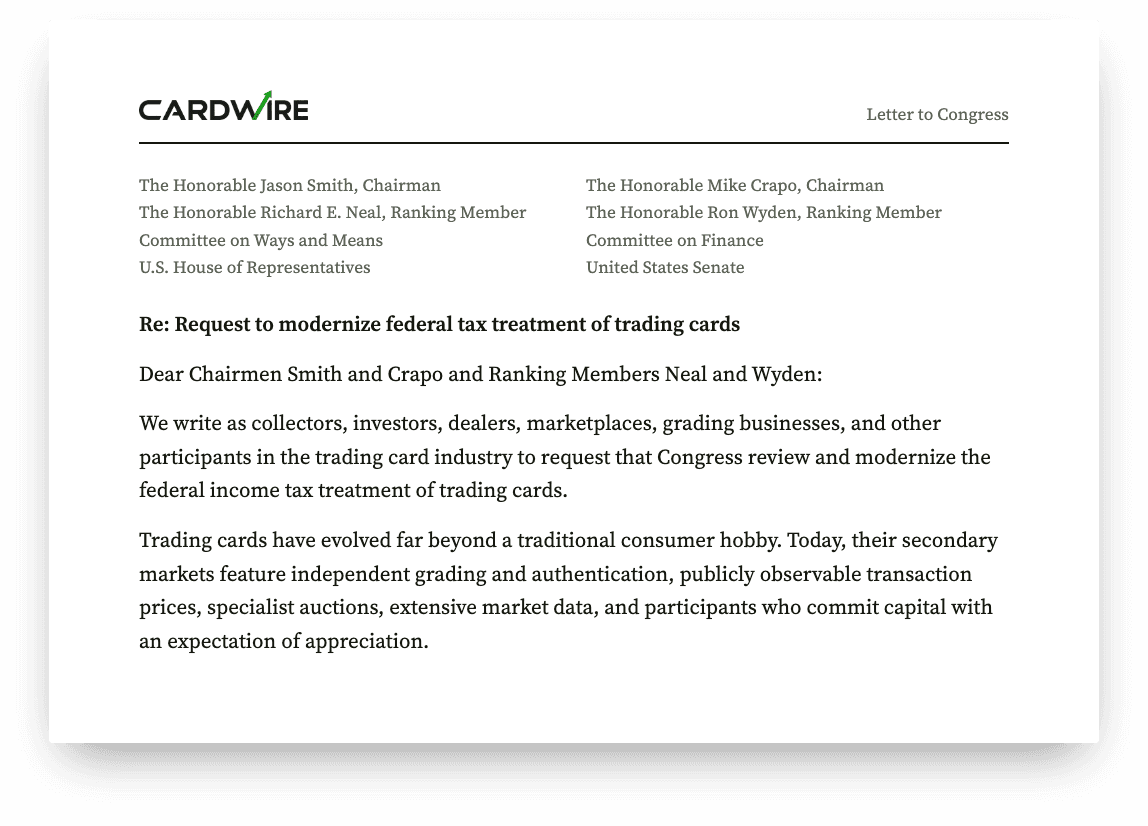
READ AND SIGN THE LETTER TO CONGRESS
By signing, you authorize CardWire to include your name and any affiliation you choose to provide among the signatories to the letter submitted to Congress.