
Autographs Are Not What Makes a Card Scarce
The hidden economics of autographed collectibles and the dangers of investing in false scarcity.
The market generally overvalues modern autographs.
Investors often treat the signature as the scarce part of the card, when for a living, active player the real shortage usually comes from somewhere else.
A Cooper Flagg autograph sold for $366,000 USD at Goldin in March 2026, but the price investors pay for the finished card has little connection to what Flagg was paid to sign it. His compensation was negotiated upstream, through licensing and an individual Fanatics agreement. The card company then decided what product would carry the signature, how many versions to make, which would be numbered, and which would be a one-of-one. By the time a card reaches the secondary market, the athlete has already been paid.12
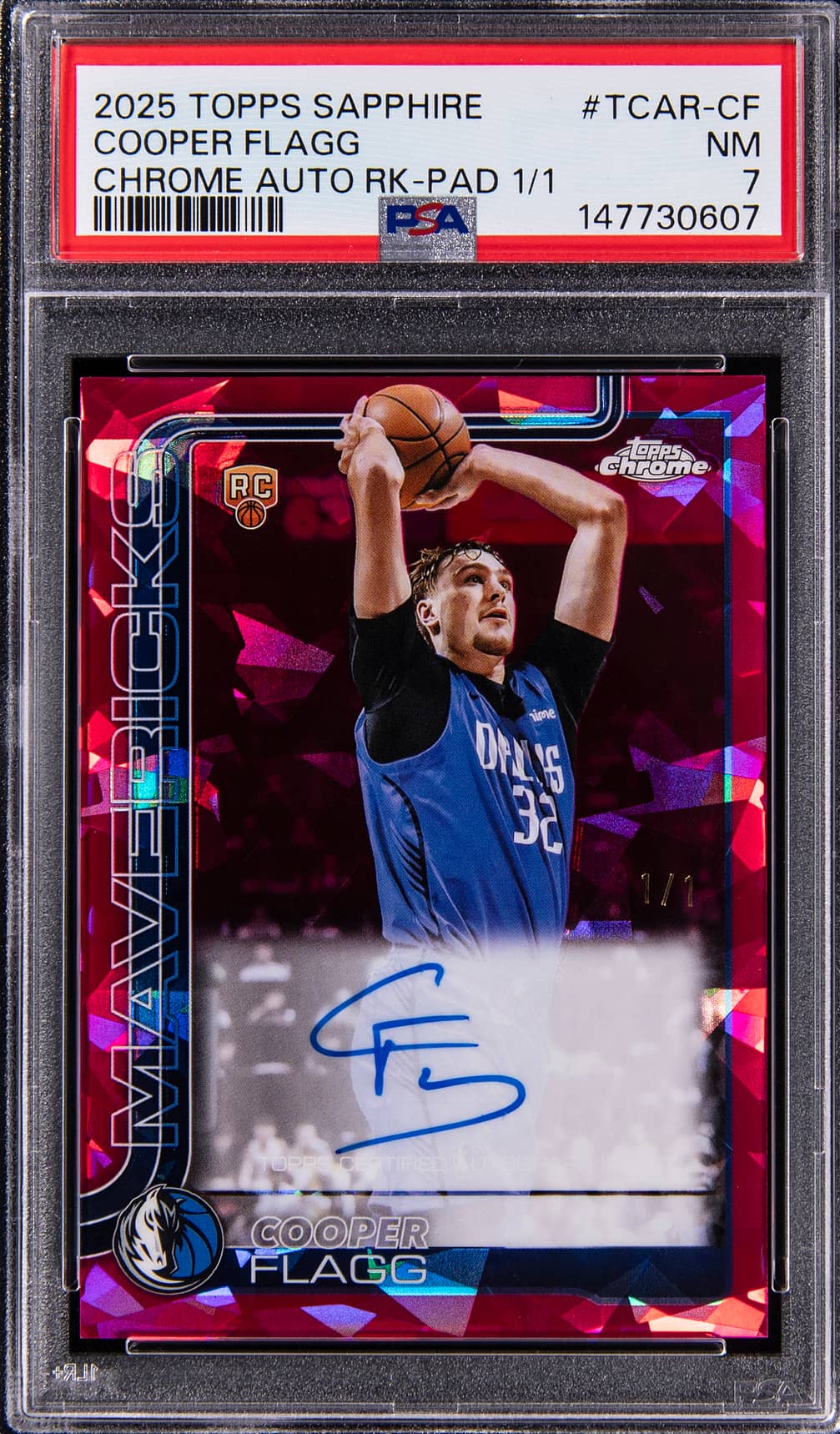
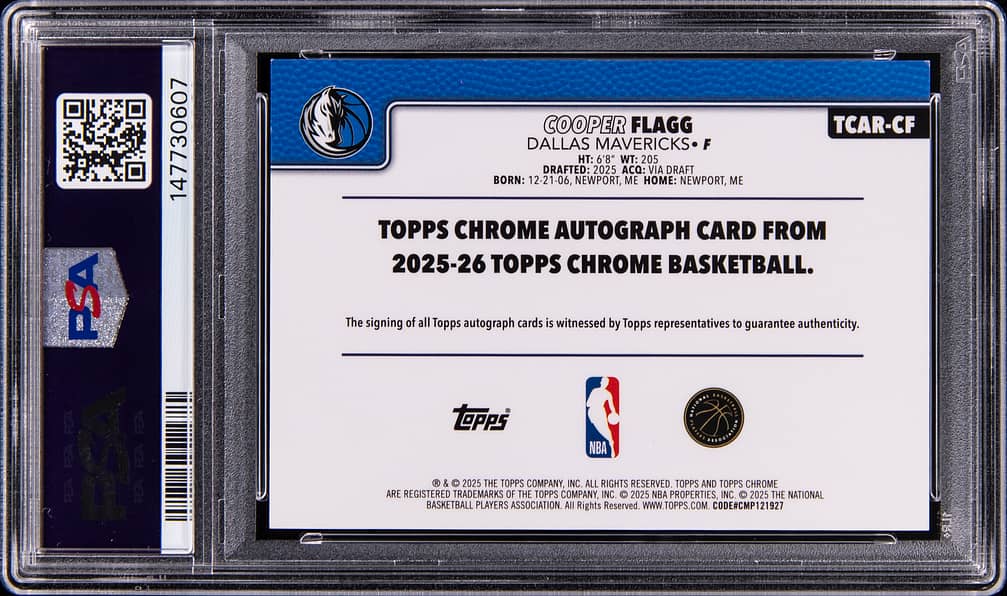
The specific card can be scarce. The signature can be expensive, exclusive, difficult to obtain and enormously valuable to investors, but its total supply has no natural fixed ceiling. A player can sign 5,000 cards this year and thousands more next year.
The economics become clearer once you see how players are paid and how autograph inventory is produced.
How does a player get paid for autographs?
There are two basic layers of player compensation in licensed sports cards. The first is group licensing. Players' associations license player names and likenesses across a roster, allowing a manufacturer to make an official league product without negotiating a separate base-card deal with every player. The formulas differ by sport, but this is product licensing, not a royalty every time one specific player's card is printed.3
The second layer is the player's individual deal. This is where the economics get much more interesting. Stars, top rookies and desirable signers can negotiate directly with a manufacturer for autographs, memorabilia, exclusivity, appearances, marketing and other obligations. These agreements can be worth far more than the player's share of a general licensing pool.
Marvin Harrison Jr.'s dispute with Fanatics gave the public a rare look at a modern agreement. A term sheet made public in the litigation in July 2024 called for a $1.05 million USD guarantee, split between cash and Fanatics equity, along with more than 35,000 autographs, jerseys, appearances, social content and other obligations. It also stated a $30 USD autograph fee and a $10 USD inscription fee, plus potential bonuses.4
Guaranteed to Marvin Harrison Jr. for one year under the Fanatics term sheet made public in July 2024: $800,000 USD in cash and $250,000 USD in Fanatics equity.
Minimum autographs the sheet required, with an option for 15,000 more.
The stated fee per autograph, plus $10 USD per inscription, alongside jerseys, appearances and social obligations.
The manufacturer is not simply buying a signature for $30 USD. It is buying a broader commercial relationship with the athlete, then measuring part of the signing obligation in units. The guarantee, equity, memorabilia and marketing have their own value. The autographs are just one part of the package.
Cooper Flagg signed an exclusive, multi-year trading card and memorabilia agreement with Fanatics while he was still at Duke. The financial terms are private. Fanatics secured the athlete relationship before he was even drafted into the NBA.2
In 2009, twelve NBA players sued Topps over signatures they had agreed to provide between February and September 2008, in quantities from 500 to 10,000 each, at fees running from $3 USD to $50 USD per signature. Derrick Rose contracted for 10,000 autographs at a $25 USD fee per signature, and Tracy McGrady for 1,000 at $50 USD, the highest rate in the suit. Those rates are useless as modern benchmarks. But the insight is important: Topps buys a quantity of signatures at a unit price, knowing what they would sell the cards for later.5
Modern autographs are not scarce
The scale is easy to miss because investors usually encounter one finished card at a time. The manufacturer encounters signatures as inventory.
Sticker autographs make this obvious. The player signs transparent labels in bulk, sometimes thousands at a time. Those labels go back to the manufacturer and can be applied later during production. Topps explains that stickers solve scheduling and production problems when on-card signing is impractical. Upper Deck has described the advantage even more directly: labels can allow an athlete to complete much of a season's autograph demand in one sitting.67
Harrison's term sheet required more than 35,000 autographs. That is a modern contract asking one player for tens of thousands of signatures.4
The signature may look unique once it is attached to a numbered card, but the ink itself may have come from a large pool of interchangeable signed labels. The athlete signed the label before the final card existed and before anyone knew whether it would end up on a base autograph, a /99, a /10 or a one-of-one.
For this reason, on-card autographs are better. The athlete physically handled the card, the signature is part of the object rather than a label added later, and the production process is more cumbersome. Those are rational reasons to pay a premium for on-card ink.6
But on-card does not create a lifetime cap on the athlete's signature. A 2026 Flagg one-of-one is permanently one-of-one. Flagg can still sign a different Topps card in 2027, another in 2028 and thousands more over the course of his career. On-card creates a stronger connection to the cardboard. But it does not make the underlying autograph supply fixed.
The manufacturer creates the scarcity
Investors see the signature and serial number fused together on one slab, but they come from different supply systems.
The athlete controls whether he signs. The manufacturer controls the print run. They decide how many base autos to make, how many parallels to create, which versions will be /99, /25, /10 /5, or 1/1. The scarcity of the card is designed and intentional, not by a natural shortage of the athlete's ability to write his name. Topps has been testing on-demand production with LeBron James's first 76ers card. The base is $5 bucks, but the chase is one autograph redemption for one lucky winner.
That becomes extreme at the top of the market. A one-of-one is worth orders of magnitude more than a common autograph from the same player, even though both signatures came from the same hand and may have been produced under the same broader athlete agreement and signed on the same day. The market premium is therefore doing much more than pricing the autograph. It is pricing the particular card, its serial number, its rookie status, its patch or memorabilia, its design, its condition and its place in the player's card history.
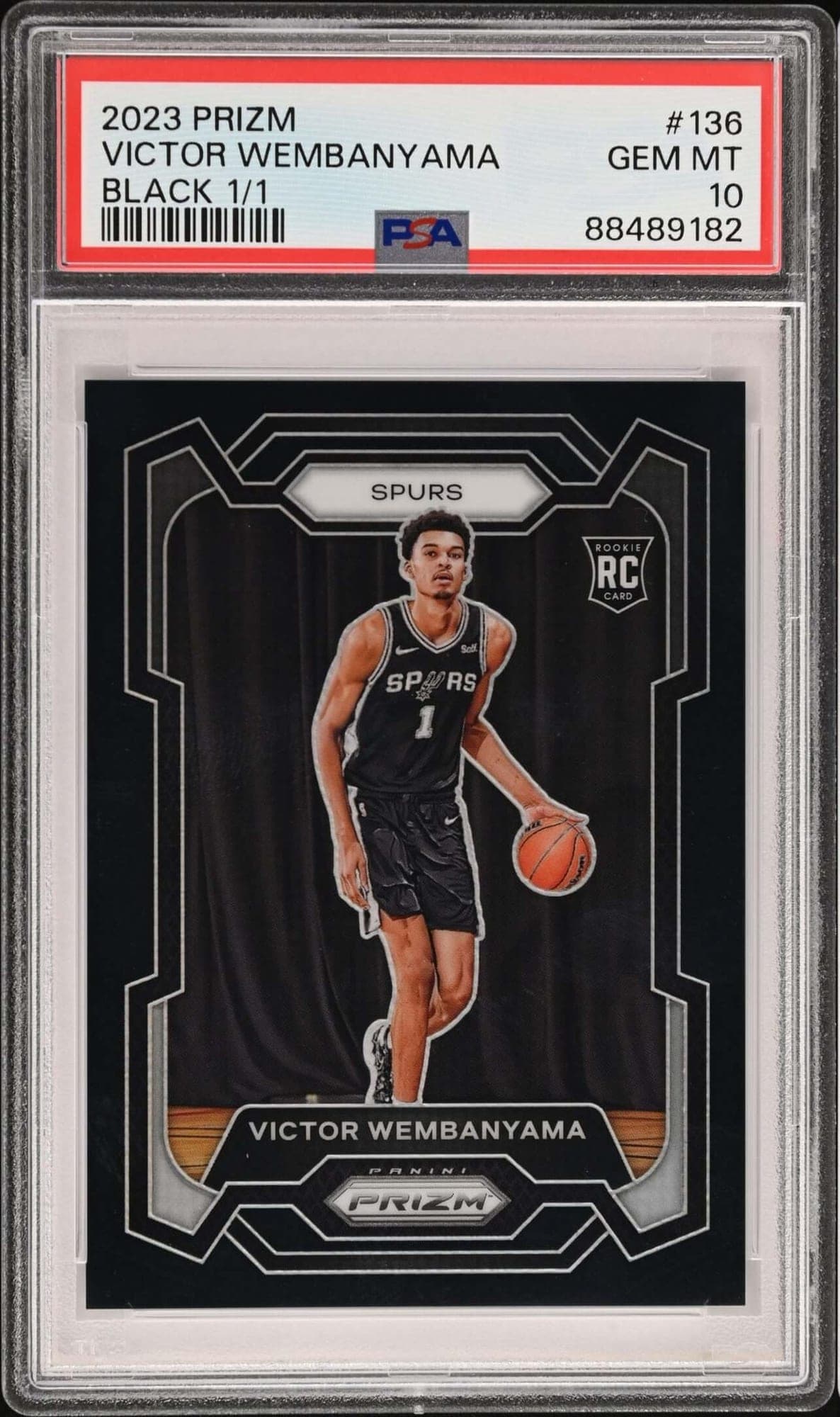
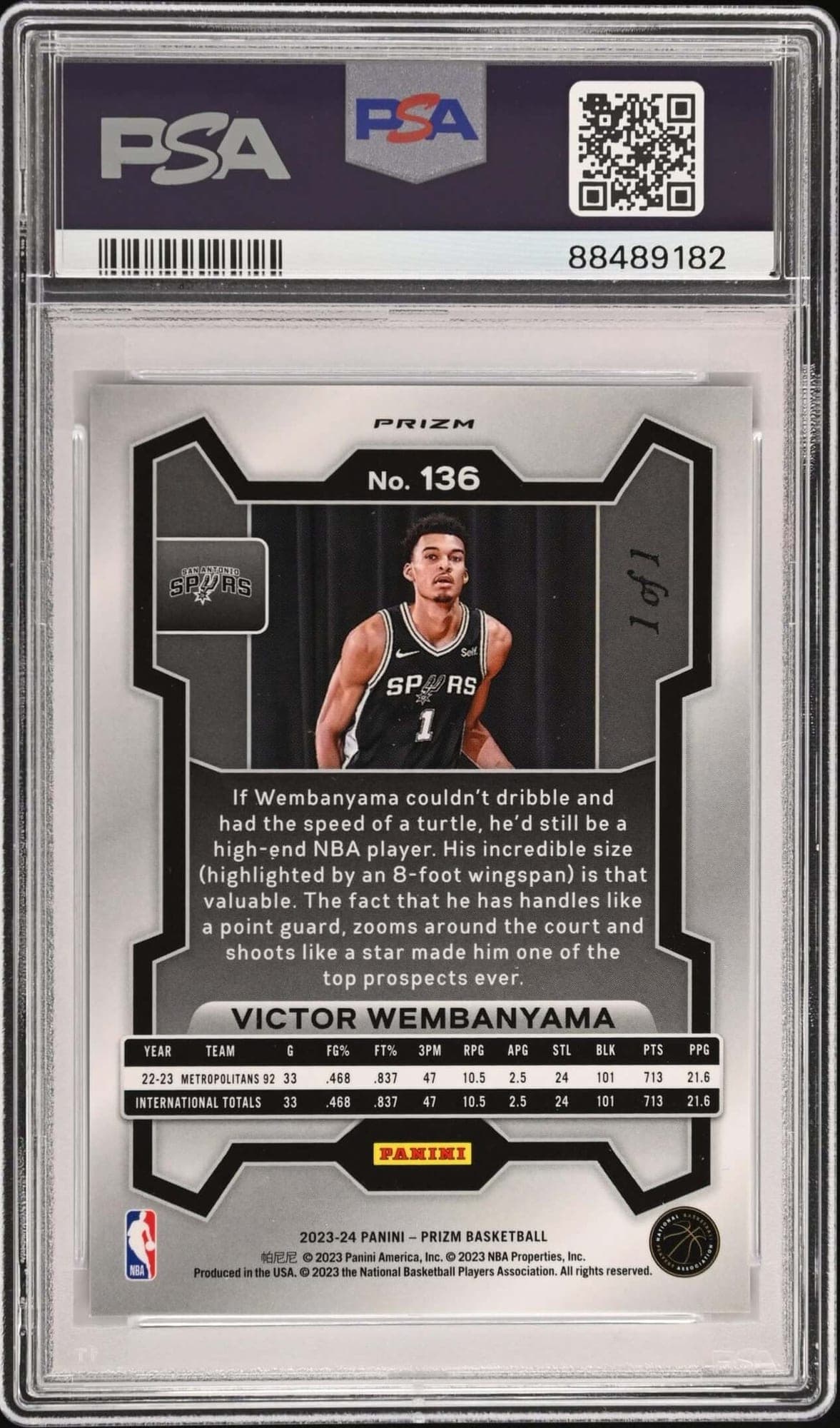
The highest publicly recorded basketball card sale of 2026 isn't even an auto. Victor Wembanyama's 2023-24 Panini Prizm Black one-of-one rookie, graded PSA 10, sold privately for $5.11 million USD in May 2026 without an autograph.89 The market did not need ink to create a multimillion-dollar card. The scarcity of the object was enough.
What investors are actually paying for
None of this means autographs have no value. They plainly do. A signature adds identity, connection and, especially when it is on-card, a direct physical link between the athlete and the cardboard. An autograph can also make a card culturally more important and can be the defining feature of an iconic release.
But the market often prices the presence of a signature as though the signature itself were the scarce asset. For living, active players, that is the weak link in the logic. The athlete can keep signing. Manufacturers can keep commissioning new autograph products. A sticker inventory can be replenished. A new season can produce a new crop of numbered autograph cards.
The result is an enormous and continually expanding population of "scarce" autographs. Each individual card may be rare, but the broader category of signed cards from the same player keeps growing.
Sticker autos deserve the most skepticism. They combine the weakest physical connection to the card with the clearest evidence of bulk production. A sticker attached to a /10 may be part of a card with a print run of 10, but the autograph itself may be one of thousands signed in the same batch. Investors are paying for the /10 whether they recognize it or not.
On-card autos sit higher in the hierarchy because the player signed the actual object. But even there, the durable scarcity still comes primarily from the card itself. The one-of-one, the rookie year, the patch, the iconic design and the specific cardboard cannot simply be reproduced as the same card. Another autograph can be. Grading works the same way. A PSA 10 carries a premium over a PSA 9 of the same card because it's harder to preserve a card in gem mint, let alone pull it in the first place.
This argument is about living, active players. Once a player dies, the supply of authentic signatures closes. A deliberately restrictive exclusive arrangement can also constrain supply. Michael Jordan's long-standing exclusive relationship with Upper Deck is the obvious example.9 Those are different economics from an active player who signs large quantities for modern products year after year.
The price of ink
Sports card investors have spent years learning to distinguish a /99 from a /10, a base rookie from a true one-of-one, a generic relic from a game-used patch, and a PSA 9 from a PSA 10. The same discipline should be applied to the autograph.
For a living player, a signature usually has no fixed lifetime supply. It can be valuable without being scarce. The card company can buy thousands of signatures, hold sticker inventory, commission more on-card signings and introduce new autograph products for years. What it cannot do is make another copy of the specific one-of-one already in your hand.
For investors, the more durable question is not simply whether a card is signed. It is what, exactly, cannot be made again.
Notes
- Sports Collectors Daily, March 8, 2026, on Goldin's sale of Cooper Flagg's 2025-26 Topps Chrome Sapphire Edition Padparadscha one-of-one rookie autograph, graded PSA 7, for $366,000 USD. sportscollectorsdaily.com ↩
- The Athletic, January 17, 2025, "Duke's Cooper Flagg signs multi-year trading card and memorabilia deal with Fanatics." nytimes.com/athletic Sports Collectors Daily, July 17, 2026, on Flagg signing his Rookie Debut Patch Autograph at Fanatics Fest. sportscollectorsdaily.com ↩
- Group licensing background from the NFLPA's licensing program (the "Rule of 6" group license), MLB Players, Inc., the NHLPA, and the 2023 NBA Uniform Player Contract. Structures and distribution formulas differ by sport; the article uses this only to distinguish collective product licensing from individual autograph agreements. nflpa.com ↩
- ESPN, July 10, 2024, reporting the Marvin Harrison Jr. Fanatics term sheet made public in New York State Supreme Court: a $1.05 million USD Phase 2 guarantee, $800,000 USD in cash and $250,000 USD in Fanatics equity, a minimum of 35,000 autographs with an option for 15,000 more, a $30 USD stated autograph fee, a $10 USD inscription fee, plus jerseys, appearances, social obligations and bonuses. espn.com ↩
- Rich Mueller, "NBA Players Suing Topps Over Autographs," Sports Collectors Daily, August 31, 2009, from court papers in a New York suit brought by twelve NBA players. The filing put the 2008 signing agreements at 500 to 10,000 autographs each at $3 USD to $50 USD per signature, with Derrick Rose at 10,000 at $25 USD and Tracy McGrady at 1,000 at $50 USD; the suit sought $298,560 USD after Topps cancelled the remaining signatures when Panini took the exclusive NBA license. sportscollectorsdaily.com ↩
- Topps Ripped, March 5, 2025, "On-card autograph cards vs sticker autograph cards: what's the difference?" ripped.topps.com ↩
- Upper Deck, "Ask UD: preventing redemptions, athlete signings, schedules and replacements," published June 22, 2011 and modified September 12, 2025. upperdeck.com ↩
- ESPN, May 26, 2026, reporting the $5.11 million USD private sale, via Fanatics Collect and confirmed by Fanatics, of Victor Wembanyama's 2023-24 Panini Prizm Black one-of-one rookie, PSA 10, a card with no autograph. espn.com ↩
- Sports Collectors Daily, March 17, 2015, on Upper Deck's renewal with Michael Jordan, which the company said would limit the number of Jordan autographs. sportscollectorsdaily.com GlobeNewswire, July 9, 2026, on Upper Deck extending the exclusive relationship and naming Jordan its first Legacy Partner. globenewswire.com ↩